Most students earning money online in 2026 are doing it the hard way — delivering food, tutoring for hours, selling stock photos that earn pennies. These methods work, but they all share the same fundamental limitation: you trade time directly for money at a fixed rate. Stop working, stop earning.
AI side hustles break that equation.
The best AI-powered income streams for students in 2026 combine genuinely low startup costs (most start with free tools), skills that improve over time rather than resetting each week, and output that earns money whether you are in class, asleep, or on semester break.
More importantly, these are not theoretical future opportunities. Students are earning real, documented income from every model on this list right now — using the same free AI tools available to anyone with a laptop and an internet connection.
This guide covers the 10 best AI side hustles for students in 2026 — with realistic income ranges, the specific tools to start with, and the exact steps to get your first payment.
Quick Answer
What are the best AI side hustles for students in 2026? The best AI side hustles for students are: AI freelance writing and content creation (fastest path to first income), faceless YouTube channels (best long-term passive income), selling AI-generated digital products on Etsy or Gumroad (scales without time investment), AI thumbnail and graphic design services (low competition, high demand), social media management with AI (consistent recurring revenue), and prompt engineering consulting (premium rates, growing market). All can be started with free AI tools and zero upfront investment.
Why AI Side Hustles Work Especially Well for Students
Students have specific constraints that make most traditional side hustles impractical — unpredictable schedules, campus housing without home offices, limited startup capital, and time that fragments across classes, assignments, and social commitments.
AI side hustles fit the student lifestyle better than any previous income model for three reasons:
Location independence. Every side hustle on this list requires nothing but a laptop and internet. Work from your dorm room, the library, a coffee shop, or your hometown during semester break. No commute, no set location, no equipment beyond what most students already own.
Asynchronous income. The most powerful AI side hustles generate income that is not tied to your active hours. A YouTube video earns AdSense revenue whether you are in an 8am lecture or pulling an all-nighter before finals. A digital product on Etsy sells at 2am without you touching it.
Compounding value. A delivery shift earns the same hourly rate whether it is your first day or your third year. AI side hustles compound — your YouTube channel grows, your client portfolio improves your rates, your digital product library generates more passive income. Four years of building during university produces something most graduates do not have: income infrastructure.
Free tool access. Every side hustle on this list can be started with free tools — Claude free tier, ChatGPT free, Canva free, CapCut free, ElevenLabs free tier. The capital requirement to start is effectively zero.
The 10 Best AI Side Hustles for Students
1. AI Freelance Writing and Content Creation
Startup cost: $0 Time to first income: 1 to 2 weeks Realistic monthly income: $300 to $3,000+ Best for: Students who write well and want the fastest path to paid work
Businesses need content constantly — blog posts, articles, email sequences, social media copy, product descriptions, website pages. Most businesses do not have dedicated writers. Most cannot afford agency rates. This gap is where student freelance writers with AI tools can earn real money immediately.
Why AI changes the economics for student writers:
Without AI, producing a 2,000-word SEO article takes a skilled writer 3 to 5 hours of research, outlining, drafting, and editing. With Claude or ChatGPT as a first-draft assistant and Perplexity for research, the same article takes 60 to 90 minutes — and the quality is higher because the AI handles structural consistency while you focus on expertise, voice, and accuracy.
This does not mean publishing unedited AI output. It means your time is spent on the parts that require human judgment — fact-checking, adding genuine expertise, writing in the client's voice, adding specific examples — while AI handles the structural heavy lifting.
The income model:
Entry-level content writers on Fiverr and Upwork earn $0.03 to $0.05 per word. Student writers with a portfolio earn $0.10 to $0.15 per word. Experienced content writers with demonstrated SEO results earn $0.20 to $0.50 per word.
A 2,000-word article at $0.10 per word is $200. With an AI-assisted workflow, producing that article takes 90 minutes. That is over $130 per hour effective rate — significantly above any campus job or food delivery platform.
Getting your first client — step by step: Step 1: Choose a niche you already know
Pick a topic where you have genuine knowledge — your
major, your hobbies, your industry interests.
AI produces better output when you can direct it
accurately, and clients pay more for niche expertise. Step 2: Create 3 sample articles with AI assistance
Use Claude to help draft, use Perplexity to research,
add your own expertise and voice. These samples are
your portfolio — write them to the standard you want
to be hired at. Step 3: Create a Fiverr or Upwork profile
Add your samples, describe your niche, set your rate
at $50 to $75 per article to start (lower than your
target, higher than beginner rates). Step 4: Write personalized proposals
For Upwork jobs, use ChatGPT to help write specific,
tailored proposals for each job — but add personal
details that show you read the actual job post. Step 5: Deliver outstanding work on your first
3 to 5 projects
Use reviews from early clients to raise your rates.
Most students who treat this seriously are charging
$100 to $150 per article within 60 days.
Tools: Claude AI (writing), Perplexity AI (research), Grammarly (proofreading), Google Docs (delivery)
Platform: Fiverr, Upwork, direct outreach to small businesses in your niche
For more on building a freelance income with AI tools, read the complete freelancing with AI guide.
2. Faceless YouTube Channel
Startup cost: $0 Time to first income: 3 to 6 months Realistic monthly income: $500 to $10,000+ (at scale) Best for: Students who want the best long-term passive income asset
A faceless YouTube channel built on AI tools is the highest-ceiling side hustle on this list for students who are willing to be consistent over 6 to 12 months. The income is genuinely passive once a channel reaches scale — videos published during semester one earn AdSense revenue in semester four without any additional work.
The academic calendar actually helps. Summer breaks and semester breaks are intensive production periods where you can batch-produce 20 to 30 videos. During exam periods, previously published videos keep earning.
The student-specific advantage:
Your university studies give you genuine expertise in topics that make excellent faceless YouTube channels — economics, psychology, history, science, law, technology. A student studying finance has more authentic expertise for a personal finance channel than most of the generic faceless channels already on YouTube. That expertise, channeled through AI-assisted production, creates content that is both efficient to produce and genuinely valuable to watch.
Income breakdown at different channel sizes:
A finance or technology channel at 10,000 monthly views generates approximately $80 to $250/month from AdSense alone. Add affiliate commissions from financial tools, productivity software, or relevant services and the same channel earns $300 to $800/month. At 100,000 monthly views, that scales to $800 to $2,500/month AdSense plus $1,000 to $3,000/month affiliates.
Channels in high-CPM niches like finance, technology, and business reach these numbers faster than general interest channels.
AI production workflow for students:
Use Perplexity for topic research (20 minutes), Claude for script writing (45 minutes), ElevenLabs for voiceover (20 minutes), Pexels for stock footage (free), CapCut AI for editing with auto-captions (60 minutes), Canva and ChatGPT for thumbnail (15 minutes). Total: 2.5 to 3 hours per video with zero production cost beyond your laptop.
For the complete faceless channel setup, read the how to start a faceless YouTube channel with AI guide and the best AI tools for YouTube automation.
Tools: Claude AI, ElevenLabs, CapCut AI, Canva AI, Perplexity AI, ChatGPT
3. Selling AI-Generated Digital Products
Startup cost: $0 Time to first income: 1 to 3 weeks Realistic monthly income: $200 to $2,000+ Best for: Students who want passive income that earns while they sleep
Digital products — templates, guides, prompt packs, planners, worksheets, eBooks — are created once and sold indefinitely. With AI tools, a student can create a professional-quality digital product in an afternoon and list it on Etsy or Gumroad the same day.
Highest-selling AI digital products for students:
Canva templates — Social media template packs, resume templates, presentation templates, planner pages. Canva templates sell consistently on Etsy with minimal competition in niche categories. Use Canva's template tools to build, export as Canva links or PDFs, and list.
AI prompt packs — Collections of proven AI prompts organized by use case. "50 ChatGPT Prompts for College Students," "30 AI Prompts for Essay Writing," "AI Prompts for Job Applications." These are zero-cost to produce and sell at $5 to $15 each. High volume, simple product.
Related articles
AI Tools
7 Best AI Thumbnail Generators for YouTube in 2026 (Free and Paid)
Discover the 7 best AI thumbnail generators for YouTube in 2026. Tested and ranked for design quality, ease of use, free plan value, and CTR performance. Create professional thumbnails in minutes.
AI Tools
AI SEO vs Traditional SEO: Complete Comparison for 2026
AI SEO vs traditional SEO — complete comparison covering what changed, what stayed the same, and how to optimize content for both Google rankings and AI search engines in 2026.
Study and productivity templates — Notion templates, Google Sheets trackers, study planners. Students buy these constantly. AI helps you build them faster and design them more professionally.
Niche eBooks and guides — Use Claude to help write a 5,000 to 10,000 word guide on a topic from your major or a skill you have developed. Price at $9 to $29. Genuinely useful guides in specific niches sell consistently without marketing if the Etsy or Gumroad listing is well-optimized.
Getting your first sale — the Etsy approach:
Etsy has built-in search traffic — you do not need a social media following to make sales. Research what types of digital products are selling in your niche using Etsy's search bar (products showing "Bestseller" badges are validated demand). Create a better version with AI tools. Optimize your listing title and description for Etsy search. Your first sale often arrives within 2 to 4 weeks.
Tools: Canva AI (design), Claude AI (writing), ChatGPT (product ideation), Gumroad or Etsy (sales platform)
4. AI Thumbnail and Graphic Design Services
Startup cost: $0 Time to first income: 1 to 2 weeks Realistic monthly income: $400 to $2,500+ Best for: Students comfortable with visual tools who want consistent recurring clients
YouTube channels, podcasters, newsletter writers, and course creators all need consistent visual content — thumbnails, cover art, social media graphics, infographics. Most cannot justify hiring a full-time designer. They want someone reliable who delivers quality visuals quickly at reasonable rates.
Students with an eye for design and knowledge of the AI tools covered in this blog can fill this need profitably — using ChatGPT for image generation, Canva AI for assembly and brand application, and Ideogram for text-in-image requirements.
Why this works especially well in 2026:
The AI tools that produce professional-quality visual content are now free and accessible. The skill advantage a professional designer had through Photoshop expertise has partially collapsed. What remains — and what clients genuinely value — is design judgment: knowing what looks good, understanding what CTR-optimized thumbnails require, and being able to work within a client's brand consistently.
Students who can demonstrate that judgment through a portfolio earn rates that would have required years of Photoshop experience previously.
Service packages that sell:
Monthly thumbnail retainer (20 thumbnails/month): $200 to $400/month Single thumbnail rush delivery: $25 to $50 each Social media graphic pack (30 posts): $150 to $300 Podcast cover art: $50 to $150 (one time) YouTube channel art package: $100 to $200 (one time)
A student managing 5 YouTube clients on monthly thumbnail retainers at $250/month each earns $1,250/month passively — once the clients are established, delivery takes 3 to 4 hours per client per month with AI tools.
Building the client base:
Start on Fiverr with a strong thumbnail portfolio (create 10 sample thumbnails for fictional channels covering different niches). Price at $20 to $30 per thumbnail initially for reviews. After 10 reviews, raise to $40 to $50. Direct outreach to YouTube channels in a specific niche (comment genuinely on videos, then message the creator) converts better than Fiverr for retainer clients.
Tools: ChatGPT DALL-E (image generation), Canva AI (assembly), Ideogram (text in image), Microsoft Designer (free backup)
For more on AI thumbnail creation, read the best AI thumbnail generators for YouTube guide.
5. Social Media Management with AI
Startup cost: $0 Time to first income: 2 to 3 weeks Realistic monthly income: $300 to $2,000+ per client Best for: Students who understand social media and want recurring monthly income
Small businesses, local restaurants, fitness studios, real estate agents, and consultants all need social media presence — and almost none of them have the time or expertise to manage it effectively. A student who can take this off their plate earns recurring monthly income for consistent work that AI makes dramatically more efficient.
What social media management actually involves:
Without AI: Content research (2 hours/week), caption writing (3 hours/week), graphic creation (4 hours/week), scheduling (1 hour/week). Ten hours per client per week — nearly impossible to scale beyond one or two clients.
With AI: Perplexity for trend research (30 minutes/week), Claude for caption batches (45 minutes/week), Canva AI for graphics from templates (60 minutes/week), Buffer for scheduling (30 minutes/week). Three hours per client per week — scalable to 4 to 6 clients simultaneously.
Pricing structure for student social media managers:
Starter package (3 posts/week, 1 platform): $300 to $400/month Standard package (5 posts/week, 2 platforms): $500 to $700/month Full management (daily posts, stories, 3 platforms): $800 to $1,200/month
Four clients on standard packages generates $2,000 to $2,800/month — working approximately 12 hours per week with an AI-assisted workflow.
Getting your first client:
Your most accessible first clients are local businesses near your campus — coffee shops, independent restaurants, boutiques, fitness studios, tutoring services. Walk in, show them 3 sample posts you created for their business category, explain the package, and offer a one-month trial at reduced rate. The conversion rate on in-person pitches to local businesses significantly exceeds cold email or Fiverr listings for this service.
The AI workflow for each client: Monday — Content planning (20 min):
Use Perplexity to find trending topics in
client's niche this week.
Use ChatGPT to generate 15 post ideas —
select the best 5. Tuesday — Content creation (45 min):
Use Claude to write captions for all 5 posts.
Use Canva AI to create graphics from saved
client template.
Review and adjust for brand voice. Wednesday — Schedule and done (15 min):
Upload to Buffer, set optimal posting times,
schedule for the week.
Tools: Claude AI (captions), Canva AI (graphics), Perplexity (research), Buffer (scheduling), ChatGPT (ideation)
6. AI Prompt Engineering Consulting
Startup cost: $0 Time to first income: 2 to 4 weeks Realistic monthly income: $500 to $3,000+ Best for: Students who enjoy AI tools deeply and want premium-rate consulting work
Businesses are adopting AI tools at speed and struggling to use them effectively. The gap between what ChatGPT, Claude, and Gemini can do with expert prompting and what they produce from vague, unstructured inputs is enormous — and most business users do not know how to close it.
A student who understands prompt engineering at genuine depth can consult for businesses, create prompt libraries for specific use cases, and train teams to use AI more effectively. This is premium-rate work because it requires specific knowledge most people do not have.
What prompt engineering consulting actually involves:
Auditing a business's current AI usage and identifying efficiency gaps. Building prompt templates for their specific workflows — customer service responses, content production, data analysis. Training their team on effective prompting. Creating documentation and prompt libraries they can maintain independently.
Realistic rates for student prompt engineers:
Hourly consulting: $50 to $150/hour depending on client size Prompt library creation (50 prompts for specific use case): $300 to $800 Team training workshop (2 hours): $200 to $500 Monthly retainer (ongoing optimization): $300 to $800/month
Building the knowledge base:
Read the complete prompt engineering guide to build foundational expertise. Then specialize in a specific business context — content marketing, customer service, legal document drafting, real estate listing optimization. Deep expertise in one application area is more valuable and easier to sell than general prompting knowledge.
Finding first clients:
LinkedIn outreach to small business owners explaining specifically how you can improve their AI tool efficiency. Campus entrepreneurship networks. Local business associations. The pitch is specific: "Your team is using ChatGPT but getting generic outputs. I can build you a custom prompt system that produces results you can actually use, in 30 days."
Tools: Claude AI, ChatGPT, Perplexity, Notion (documentation)
7. AI-Powered Blog and Content Site
Startup cost: $3 to $10/month (hosting) Time to first income: 3 to 6 months Realistic monthly income: $200 to $5,000+ (at scale) Best for: Students who want to build a digital asset that appreciates in value
A content website monetized through display advertising (Mediavine, AdSense) and affiliate commissions is one of the most durable passive income assets available — and AI tools have reduced the production cost of building one by 70 to 80 percent.
The model: choose a niche with advertiser demand (personal finance, home improvement, pet care, technology), publish 50 to 100 well-researched, AI-assisted articles targeting specific search queries, and earn advertising and affiliate revenue from Google search traffic.
Why students are uniquely positioned:
A student studying a subject has genuine topical expertise that produces more authoritative content than generic content farms. A nursing student writing about medical topics, a computer science student writing about programming, a finance student writing about investing — this genuine expertise produces content that ranks better and converts affiliate offers more effectively than generic AI-written content.
The content production workflow:
Use Perplexity to research your target keyword and what the current search results miss (30 minutes). Use Claude to write a comprehensive, expert-level article (45 minutes). Edit for accuracy, add your genuine expertise and examples (30 minutes). Publish with proper SEO metadata.
This workflow produces a publication-ready article in under 2 hours. Publishing 3 articles per week produces 150 articles per year — the content foundation for a site generating thousands of monthly visitors.
Related articles
AI Tools
Gemini vs ChatGPT vs Claude for Coding: Which AI is Best in 2026?
Gemini vs ChatGPT vs Claude for coding — we tested all three on real coding tasks. Honest comparison covering code quality, debugging, explanation, languages, free plans, and which AI coder wins in 2026.
AI Tools
How to Rank in Google AI Overviews in 2026 (Complete Guide)
Learn exactly how to rank in Google AI Overviews in 2026. Complete guide covering content structure, schema markup, E-E-A-T signals, and proven strategies to appear in Google's AI-generated answers.
Revenue at different traffic levels:
| Monthly Visitors | AdSense/Mediavine | Affiliates | Total |
|---|---|---|---|
| 5,000 | $50 to $100 | $50 to $200 | $100 to $300 |
| 20,000 | $200 to $500 | $200 to $800 | $400 to $1,300 |
| 50,000 | $500 to $1,500 | $500 to $2,000 | $1,000 to $3,500 |
| 100,000 | $1,000 to $3,000 | $1,000 to $4,000 | $2,000 to $7,000 |
For more on AI SEO optimization that makes blog content rank, read the complete AI SEO guide and the how to rank in Google AI Overviews guide.
Tools: Claude AI (writing), Perplexity (research), Hostinger AI Builder (site), Canva AI (images), Grammarly (proofreading)
8. AI Video Editing and Shorts Creation Service
Startup cost: $0 Time to first income: 1 to 2 weeks Realistic monthly income: $400 to $2,000+ Best for: Students comfortable with video tools who want a high-demand service
Content creators, businesses, and coaches produce video content but lack the time or skills to edit it professionally. AI video editing tools have made professional editing accessible to anyone willing to learn the workflow — and the demand for edited short-form content is enormous.
What this service involves:
Clients send raw video footage. You edit using CapCut AI — auto-captions, silence removal, cuts, music, zooms — and deliver polished short-form content for YouTube Shorts, Instagram Reels, and TikTok. You can also repurpose long-form videos into Shorts packages using Opus Clip.
Pricing structure:
YouTube video edit (10 to 20 minutes, full edit with captions): $75 to $150 Short-form Shorts/Reels package (5 clips from long video): $50 to $100 Monthly video editing retainer: $300 to $600/month
The student advantage:
CapCut AI is free and produces results that previously required Adobe Premiere expertise. Students who can spend 2 to 4 hours learning CapCut AI's workflow can deliver professional editing results that creators and businesses would otherwise pay agencies $150 to $300 per video for.
Getting started:
Create sample edits from public domain or Creative Commons video content to demonstrate your style. List on Fiverr with a clear package description and turnaround time. Your first 5 reviews — even at reduced introductory rates — establish the social proof that converts subsequent inquiries.
Tools: CapCut AI (editing), Opus Clip (Shorts repurposing), Descript (text-based editing for interviews)
For more on AI video tools, read the best free AI video generators guide.
9. Selling Midjourney and AI Art
Startup cost: $10/month (Midjourney Basic plan) Time to first income: 1 to 3 weeks Realistic monthly income: $100 to $1,500+ Best for: Students with artistic sensibility who enjoy visual AI tools
AI-generated art from Midjourney, Adobe Firefly, and similar tools has created a legitimate market for digital prints, design assets, and creative services. Students who develop genuine skill in AI art direction — knowing how to prompt for specific aesthetics, curating quality output, and understanding what buyers want — can earn through multiple channels.
Revenue channels for AI art:
Print-on-demand (Redbubble, Society6): Upload AI-generated designs to print-on-demand platforms. Every item sold prints and ships automatically — your artwork appears on posters, phone cases, clothing, and home decor without inventory. Revenue per sale is small ($2 to $10) but scales with catalogue size and platform search visibility.
Etsy digital prints: Sell high-resolution AI art prints as digital downloads on Etsy. Buyers purchase, download, and print themselves. No inventory, no shipping. Popular categories: motivational quotes, aesthetic illustrations, map prints, nature art. Price at $3 to $15 per design, volume is the revenue driver.
Stock asset libraries: Submit AI-generated design assets — textures, patterns, backgrounds, icons — to Creative Market, Envato Elements, or Adobe Stock. Earn royalties each time assets are downloaded.
Custom commission service: Offer custom AI art generation for specific client requests — business logos in illustrated style, personalized portrait art, custom illustrations for book covers. Price at $30 to $150 per custom piece.
Important: Use Adobe Firefly for any commercial work requiring explicit copyright clearance. Understand the current platform policies for AI-generated content on each marketplace before listing.
Tools: Midjourney (premium art), Adobe Firefly (commercial clearance), Canva AI (design application), Microsoft Designer (free alternative)
10. AI Tutoring and Study Tool Creation
Startup cost: $0 Time to first income: 1 to 2 weeks Realistic monthly income: $200 to $1,500+ Best for: Strong students who want to monetize their academic expertise
Students pay for tutoring and study resources — and AI tools give knowledgeable students the ability to create high-quality educational content and services at a scale that individual tutoring cannot approach.
The two approaches:
AI-assisted tutoring service: Use Claude and ChatGPT to help you prepare exceptional tutoring sessions — generating practice problems, explaining concepts from multiple angles, creating custom study plans. Charge $20 to $50/hour for tutoring in your strongest subjects. AI preparation lets you handle more students with better outcomes.
Study resource creation and selling: Create niche study guides, practice question banks, flashcard sets, and course summary documents using AI tools. Sell on Etsy, Gumroad, or Quizlet's marketplace. A comprehensive flashcard set for a standardized exam (LSAT, MCAT, CPA, SAT) sells at $10 to $30 and generates passive income indefinitely.
The highest-value study product:
Video course creation — recording yourself teaching a subject you know deeply, using AI tools for supplementary materials, slides (Gamma AI), and editing (CapCut AI). Sell on Udemy or Teachable. Courses in competitive exam preparation, specific university subjects, or high-demand skills earn $5 to $30 per enrollment and can reach hundreds of enrollments per month.
Tools: Claude AI (content creation), Gamma AI (slide creation), Canva AI (design), ChatGPT (practice problem generation)
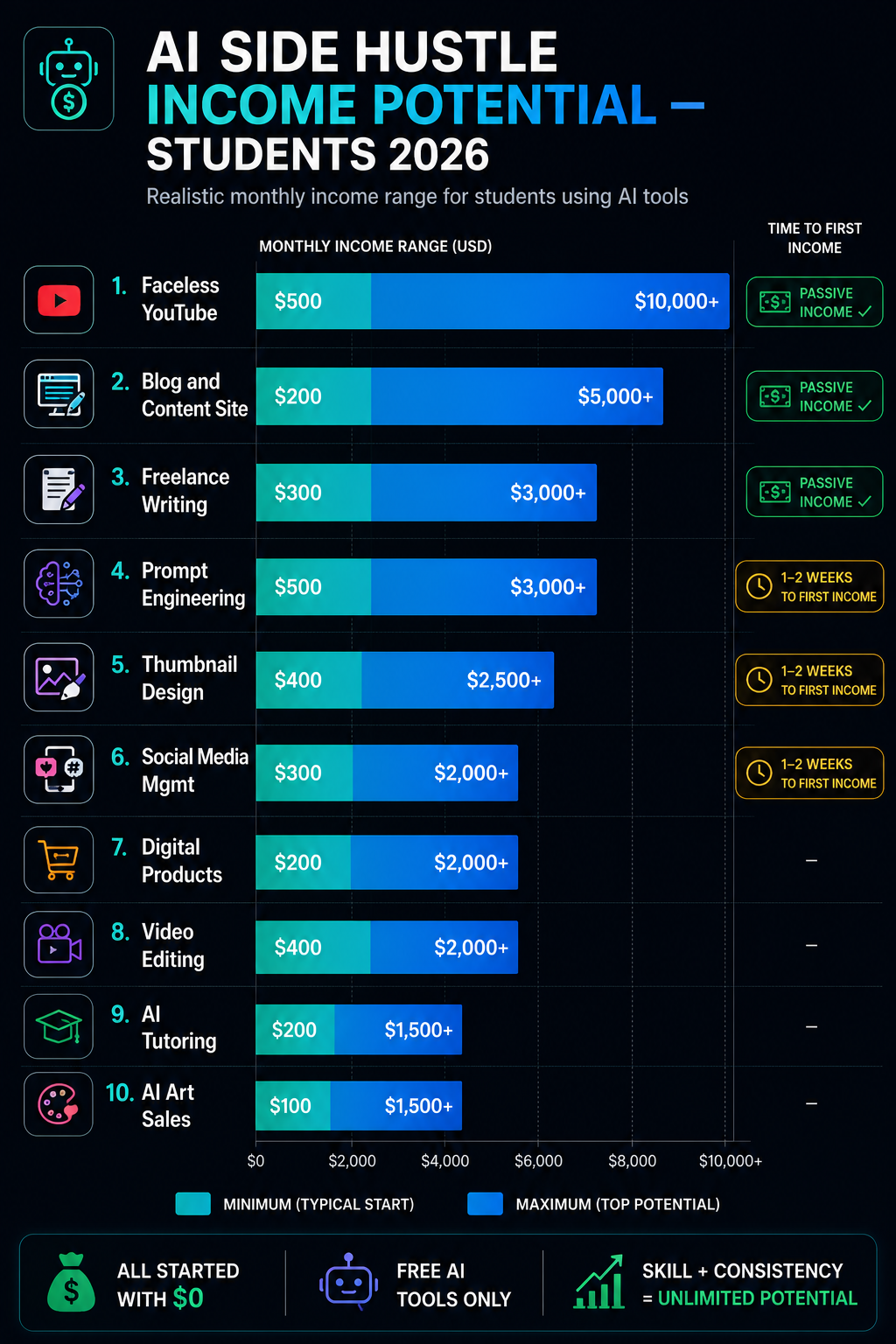
Income Comparison — All 10 Side Hustles
| Side Hustle | Startup Cost | Time to First Income | Monthly Potential | Passive? |
|---|---|---|---|---|
| AI Freelance Writing | $0 | 1 to 2 weeks | $300 to $3,000+ | Partial |
| Faceless YouTube | $0 | 3 to 6 months | $500 to $10,000+ | Yes |
| Digital Products | $0 | 1 to 3 weeks | $200 to $2,000+ | Yes |
| Thumbnail Design | $0 | 1 to 2 weeks | $400 to $2,500+ | Partial |
| Social Media Management | $0 | 2 to 3 weeks | $300 to $2,000+ per client | Partial |
| Prompt Engineering | $0 | 2 to 4 weeks | $500 to $3,000+ | Partial |
| Blog and Content Site | $3 to $10/month | 3 to 6 months | $200 to $5,000+ | Yes |
| Video Editing Service | $0 | 1 to 2 weeks | $400 to $2,000+ | Partial |
| AI Art Sales | $10/month | 1 to 3 weeks | $100 to $1,500+ | Yes |
| AI Tutoring and Study Tools | $0 | 1 to 2 weeks | $200 to $1,500+ | Partial |
The Student AI Side Hustle Starter Stack — All Free
Every side hustle on this list can be started with these free tools:
| Tool | What It Does | Side Hustles It Powers |
|---|---|---|
| Claude AI | Writing, research, content | All of them |
| ChatGPT | Writing, ideation, images | All of them |
| Perplexity AI | Research with sources | Writing, blogging, YouTube |
| Canva AI | Design, graphics, thumbnails | Design, YouTube, social media |
| Microsoft Designer | AI image generation | Thumbnails, digital products |
| CapCut AI | Video editing, captions | YouTube, video editing service |
| ElevenLabs | AI voiceover | Faceless YouTube |
| Grammarly | Proofreading | Writing, all text output |
| Buffer | Social scheduling | Social media management |
| Gumroad / Etsy | Selling platform | Digital products, art |
Total monthly cost to run all tools: $0
The only paid tool on the entire list is Midjourney at $10/month for the AI art side hustle — and Microsoft Designer provides a free alternative for creators starting out.
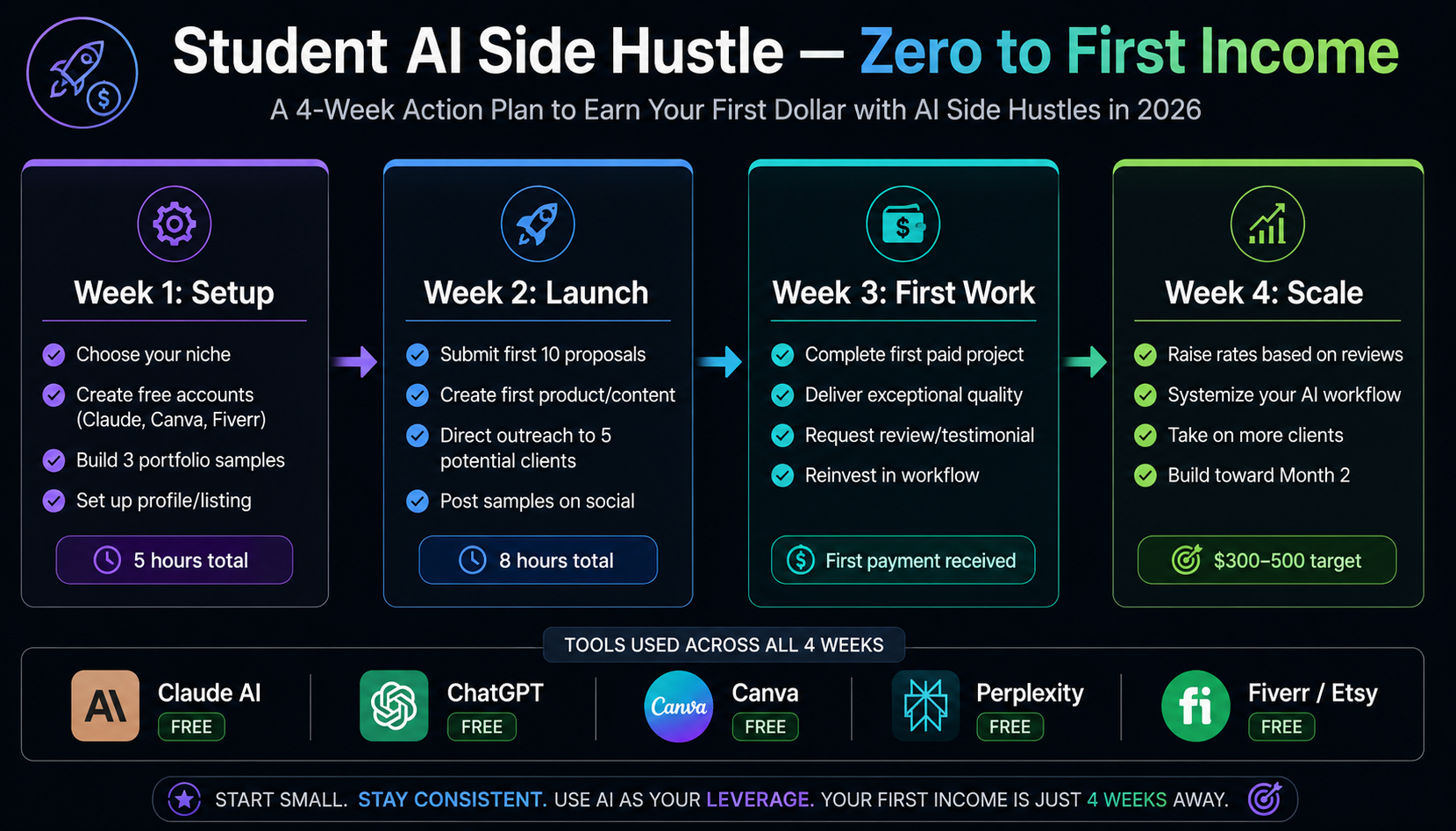
How to Choose Your First Side Hustle
The most common student mistake is trying to run two or three side hustles simultaneously before any one has generated consistent income. Pick one, commit for 60 days, and build to your first $500 before considering adding a second.
Choose based on your current situation:
If you need income within 2 weeks: AI freelance writing or thumbnail design. These have the fastest client-to-payment cycle and require the least upfront building.
If you want passive income that scales: Faceless YouTube or digital products. These take longer to generate first income but produce returns that compound without proportional time investment.
If you have a strong subject expertise: AI tutoring, blog building in your niche, or prompt engineering consulting — your knowledge is the competitive advantage that AI amplifies.
If you want recurring monthly income: Social media management or video editing retainers. Monthly retainer clients create income predictability that project-based work does not.
If you have very limited time: Digital products or AI art on print-on-demand. Create the products once, let the platform handle sales, focus on academic priorities.
Common Mistakes Students Make with AI Side Hustles
Starting too many at once. The temptation to run three side hustles simultaneously prevents any one from reaching meaningful income. Focus compounds. Pick one side hustle, build it to $500/month, then diversify.
Relying entirely on AI output without adding value. Unedited AI content is identifiable and generic. Every client, platform, and search engine eventually filters it. The students earning real money are those who use AI to amplify their genuine knowledge and judgment — not those publishing raw outputs.
Underpricing services at the start and never raising rates. Start at accessible prices to get initial reviews, but plan your rate progression. Staying at $20 per article indefinitely when you deliver work worth $80 is a motivation killer. Plan your rate increases: initial rate, 90-day rate, 6-month rate.
Not treating it like a business from day one. Track your hours, your income, and your clients. Separate your side hustle money from your personal finances immediately — even a simple spreadsheet. Students who treat their side hustle casually earn casually. Those who track and optimize earn consistently.
Giving up before the compounding kicks in. Faceless YouTube, blog building, and digital product stores all have slow early phases before traffic and income compound. Most students who start these and fail do so in month 2 or 3 — right before the traction phase. Patience through the slow phase is the actual competitive advantage.
Expert Tips for Student AI Side Hustlers
Tip 1 — Your major is your moat. Generic AI content competes with millions of other generic AI content creators. Content in your specific academic field — written with genuine expertise, fact-checked against your coursework, reflecting actual professional knowledge — competes with almost nobody. Your major is a competitive advantage that you uniquely have.
Tip 2 — Use semester breaks as sprint periods. Summer break and winter break are your highest-leverage production windows. A student who publishes 30 YouTube videos or 90 blog articles during summer break has built something that generates passive income through the following academic year. Treat semester breaks as business-building sprints.
Tip 3 — Document your learning publicly. A LinkedIn profile, a Twitter/X account, or a portfolio site that documents your AI side hustle journey builds an audience, attracts clients, and creates networking opportunities simultaneously. Students who share their results — income screenshots, lessons learned, workflow improvements — attract opportunities that those working quietly do not.
Tip 4 — Stack learning with earning. The skills built through AI side hustles — content strategy, SEO, digital marketing, client communication, AI tool proficiency — are genuinely valuable professional skills. Students who graduate with 2 years of freelance client history and demonstrable digital marketing results have a career advantage that classroom learning alone does not provide.
Tip 5 — Reinvest early income into tools that multiply output. Your first $50 earned from a side hustle is proof of concept. Your first $200 should fund one paid tool upgrade — ElevenLabs Starter, Canva Pro, or ChatGPT Plus — that immediately multiplies your output quality or volume. Students who reinvest earnings compound faster than those who cash out every payment.
For more on maximizing income from AI tools, read the complete guide to making money with AI tools.
Related articles
AI Tools
ChatGPT vs Perplexity for Research: Which AI Is Better in 2026?
ChatGPT vs Perplexity for research — honest comparison covering accuracy, sources, real-time data, depth, use cases, and which AI research tool actually saves more time in 2026.
AI Tools
Claude Fable 5 vs Claude Opus: Which Anthropic Model Should You Use?
Claude Fable 5 vs Claude Opus — complete comparison of Anthropic's AI models in 2026. Benchmarks, capabilities, pricing, safety features, and which model is right for your use case.
Key Takeaways
- The best AI side hustles for students combine free tools, flexible schedules, and income that does not require trading time 1-to-1 for money
- AI freelance writing and thumbnail design offer the fastest path to first income — typically within 1 to 2 weeks
- Faceless YouTube and digital products offer the best long-term passive income — slower to start but compounds significantly over a 2 to 4 year university timeline
- Every side hustle on this list can be started with zero upfront cost using free AI tools
- Your major and academic expertise are competitive advantages that most generic AI side hustlers do not have — use them
- Pick one side hustle and commit for 60 days before diversifying — focus at the start produces income; scattered effort produces nothing
- The students who succeed treat their side hustle as a business from day one — tracking hours, income, clients, and results
Frequently Asked Questions
What is the best AI side hustle for students with no experience? AI freelance writing is the best starting point for students with no prior side hustle experience — it requires only a laptop, uses free tools, and generates first income within 1 to 2 weeks. Begin with a specific niche related to your studies, create 3 portfolio samples using Claude, and list on Fiverr at an accessible entry price to collect initial reviews.
How much can a student realistically earn from AI side hustles? Realistic monthly income ranges from $300 to $1,000 in the first 3 months for active service-based side hustles (writing, design, social media). Passive income models (YouTube, digital products, blog) typically generate $0 to $100 in months 1 to 3, then $200 to $500 by month 6, scaling to $1,000+ by month 12 with consistency. These ranges assume 5 to 10 hours per week of consistent effort.
Can students use AI tools to earn money without any skills? AI tools dramatically lower the skill threshold required for many side hustles — producing professional-quality content, design, and code with less expertise than the pre-AI equivalent. However, entirely skill-free AI side hustles produce results that compete with thousands of others doing the same thing. Adding genuine subject knowledge, good judgment, and consistent effort differentiates income meaningfully above the minimum.
Which AI side hustle is best for passive income? Faceless YouTube channels in high-CPM niches (finance, technology, business) produce the highest passive income ceiling — channels at scale earn $1,000 to $10,000+ monthly with no ongoing time investment per historical video. Digital products on Etsy and Gumroad are the fastest path to passive income — products created in one afternoon generate sales indefinitely. Blog and content sites take longest to build but produce very durable passive income once established.
Is it ethical to use AI tools for side hustles? Yes — AI tools are productivity multipliers, not shortcuts that eliminate the value provided to clients. A writer who uses Claude to draft and edits carefully, fact-checks thoroughly, and adds genuine expertise is delivering more value than a writer who produces the same article manually. The ethical standard is delivering what clients pay for — high-quality, useful output. AI is the production tool, your expertise and judgment are the actual product.
How many hours per week does a student need for an AI side hustle? Service-based side hustles (writing, design, social media) require 5 to 15 hours per week to reach $500 to $1,500/month. Passive income models (YouTube, digital products, blog) require 5 to 10 hours per week building, then minimal maintenance once established. The AI workflow reduction means 5 hours of AI-assisted work produces output that previously required 15 to 20 hours manually.
What is the fastest way to make money with AI as a student? AI freelance writing on Fiverr or Upwork is the fastest — first income possible within 1 to 2 weeks. Create a profile, add 3 portfolio samples generated with Claude, set a competitive entry price, and actively apply to relevant job posts daily. Many students earn their first $50 to $100 within the first week of actively pursuing work.
Start Your AI Side Hustle This Week
The students who build meaningful income before graduation are not the ones who planned the perfect side hustle. They are the ones who started an imperfect one and improved it.
Every week you wait is a week of compounding you cannot recover. A faceless YouTube channel started today generates income four years from now that a channel started next semester cannot. Digital products listed this week start appearing in Etsy search while products you create next month are still being planned.
Pick the side hustle that fits your situation best from this list. Spend 2 hours this week setting it up. Spend 5 hours next week executing it. Evaluate at 30 days. Adjust and continue.
Four years of building during university while your peers are only planning produces something most graduates never have — financial independence before your career has even officially started.
Start this week. Not next semester.
For more on building income with AI tools, read the how to make money with AI tools complete guide, the complete freelancing with AI guide, the best AI tools for students guide, the how to start a faceless YouTube channel guide, and the best AI productivity tools guide — all covering the tools and strategies powering student AI income in 2026.