Google AI Overview now appears at the top of search results for hundreds of millions of queries every day. It generates a direct answer before any traditional search result appears. Before any website gets a click. Before any brand gets seen.
For content creators, marketers, and business owners, this is the most significant shift in organic search since Google launched featured snippets. The websites appearing inside AI Overview citations are capturing visibility at a scale that traditional rankings below the AI block cannot match.
The problem: most content was not built for this. Most SEO strategies still optimize for traditional ranking positions that now sit below an AI-generated block that many users never scroll past.
The opportunity: the content requirements for AI Overview citation are specific, learnable, and implementable today. Most competitors have not made these adjustments yet. The window to get in early is now.
This guide covers exactly how Google AI Overviews work, the specific factors that determine which content gets cited, and the complete implementation workflow for appearing in AI-generated answers in 2026.
Quick Answer
How do you rank in Google AI Overviews? Ranking in Google AI Overviews requires content that directly answers the specific query in the first sentence of the relevant section, uses clear headings phrased as questions, implements FAQPage and Article schema markup, demonstrates genuine expertise through specific facts and cited data, and maintains content accuracy and freshness. AI Overview pulls from pages that Google already trusts — so traditional ranking signals (quality backlinks, domain authority, strong EEAT) remain the foundation. The AI layer then selects, within that trusted set, the content that is most directly and clearly answering the query in extractable form.
What Google AI Overview Actually Is
Google AI Overview is an AI-generated answer that appears at the top of Google search results for qualifying queries. It synthesizes information from multiple trusted web sources and presents a direct answer — often with a dropdown citation panel showing the specific pages Google drew from.
It is distinct from featured snippets in several important ways. Featured snippets pull a direct excerpt from a single page. AI Overview synthesizes across multiple sources into a newly generated answer — meaning no single page's exact words appear, but 3 to 8 source pages get cited as the basis for the generated response.
This distinction matters enormously for optimization strategy. You are not trying to have your exact text lifted and displayed — you are trying to be one of the trusted sources an AI draws on to generate its own answer. The content requirements for that goal are different from traditional featured snippet optimization, though there is significant overlap.
Which Queries Trigger AI Overview
AI Overview does not appear for every search. Google deploys it most heavily for:
Informational queries — "what is," "how does," "why does," "what are the best" — questions where a synthesized answer genuinely helps the user.
Research and comparison queries — comparing options, understanding differences, evaluating approaches.
How-to and step-by-step queries — procedural content where a structured answer provides immediate value.
Complex multi-part questions — queries that would require visiting several different sources to answer completely from traditional results.
Google currently shows AI Overview less frequently for purely navigational queries (looking for a specific site), transactional queries where the user wants to purchase, and hyper-local queries requiring real-time information.
How Google Selects Sources for AI Overview
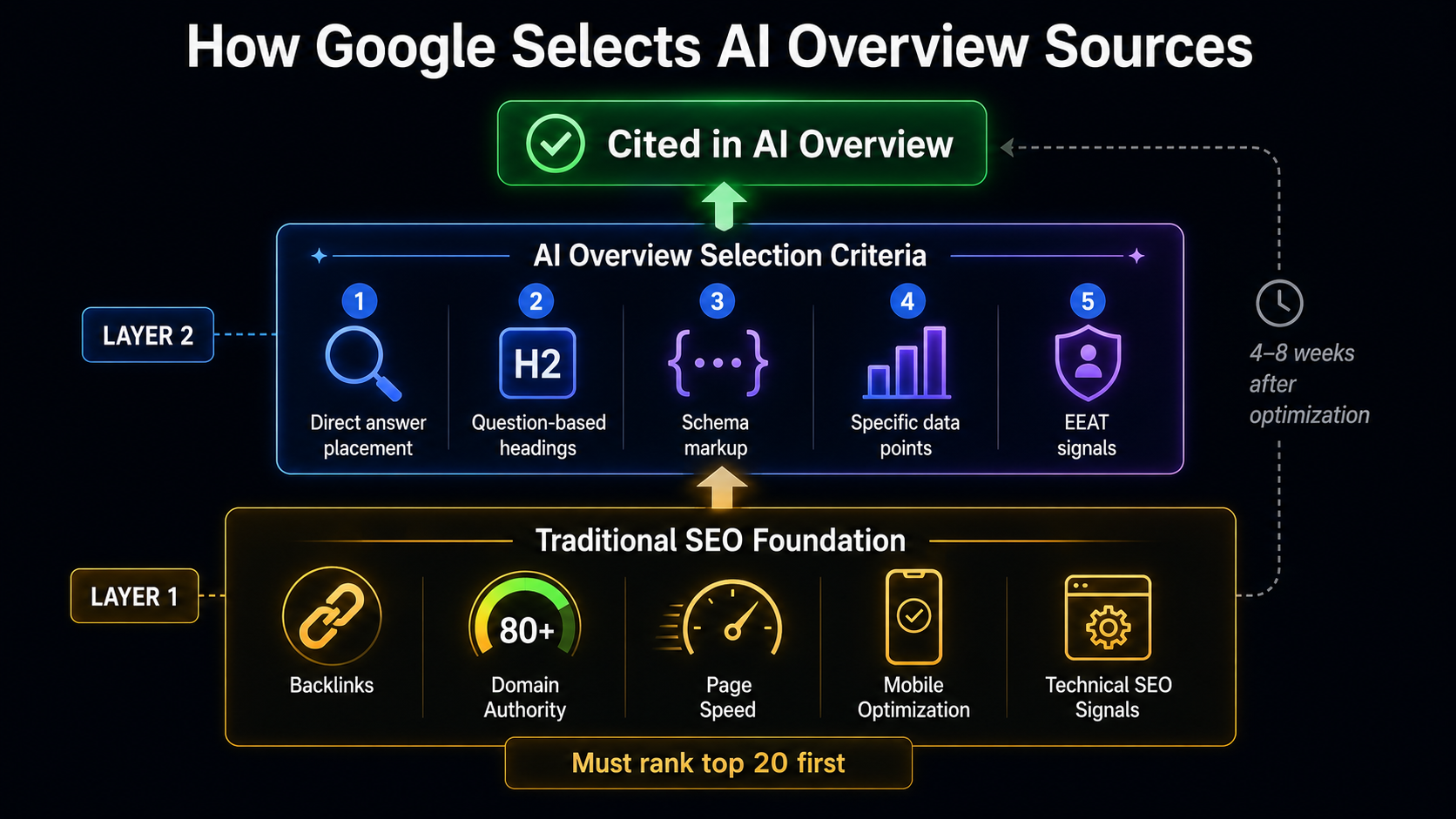
Understanding the selection mechanism is the foundation of optimization strategy. Google has not published an explicit algorithm for AI Overview citation, but the patterns across cited content reveal clear selection principles.
Foundation Layer — Traditional Trust Signals
AI Overview draws from pages Google already trusts. This means traditional SEO performance is the prerequisite, not an alternative. Pages with zero backlinks, new domains, or poor technical SEO are not cited in AI Overview regardless of how well-structured their content is.
The practical implication: AI Overview optimization is built on top of solid traditional SEO, not instead of it. If your page does not rank in the top 10 to 20 traditional results for a query, it is unlikely to appear in AI Overview for that query.
Selection Layer — Content Clarity and Extractability
Within the set of pages Google already trusts for a query, AI Overview selects those that most directly and clearly answer the query in extractable form. This is where AI-specific optimization creates differentiation.
Direct answer placement. Content that answers the core query directly within the first sentence or two of the relevant section is significantly more likely to be cited than content that builds toward the answer through extended context.
Heading structure. Pages with clear, descriptive H2 and H3 headings that match the user's query language give Google clear signals about what each section covers — making it easier to identify and extract the relevant portion.
Factual specificity. AI Overview strongly favors content with specific, verifiable facts over generic, vague statements. "Studies consistently show spaced repetition improves long-term retention" performs worse than "Research published in the journal Cognitive Psychology demonstrated that spaced repetition improved long-term retention by 200% compared to massed practice."
Multi-angle coverage. Pages that address a topic from multiple angles — including the question itself, related questions, common misconceptions, and practical implications — are more likely to be cited because they provide useful material for synthesizing a comprehensive answer.
Quality Signals — EEAT at Depth
Google's AI Overview citation process puts heavy weight on EEAT signals — Experience, Expertise, Authoritativeness, and Trustworthiness. These signals operate at both the page level and the domain level.
Author credentials. Pages with clearly identified authors, author bios, and demonstrable credentials in the relevant field are cited more frequently than anonymous content.
Primary source references. Content that cites primary sources — research studies, official data, institutional reports — signals genuine expertise rather than derivative summarization.
Publication date and update signals. AI Overview heavily favors current content. An outdated publication date or stale statistics actively reduces citation likelihood because AI systems risk their credibility by surfacing outdated information as current.
The 10 Specific Optimization Strategies
Strategy 1 — Match Your Opening Sentence to the Search Query
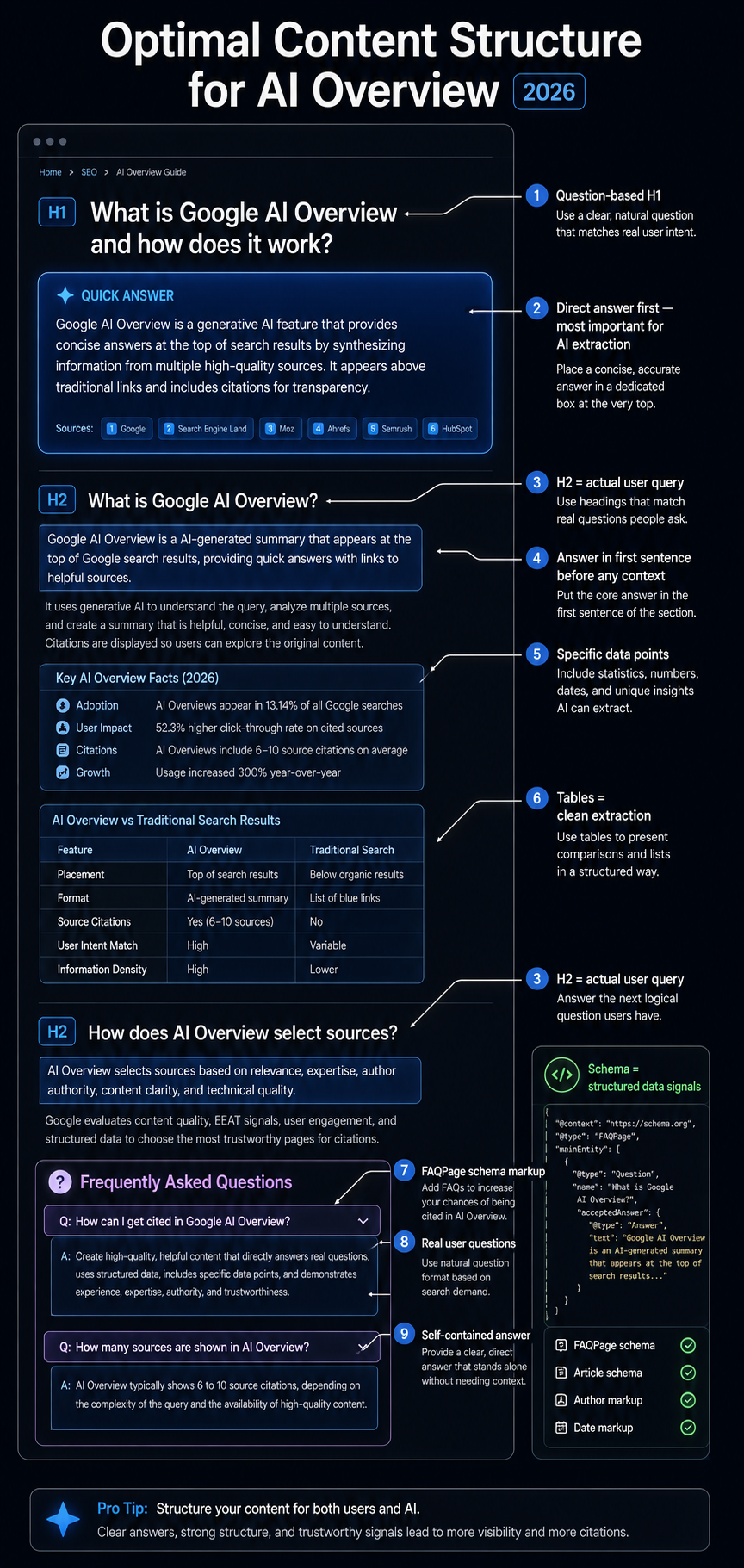
The single highest-impact structural change for AI Overview optimization: every section that targets a specific query should open with a sentence that directly states the answer to that query.
Before (poor for AI Overview): When we talk about the impact of artificial intelligence
on modern marketing workflows, it's important to first
understand the context in which these changes are happening.
Over the past several years, the marketing landscape has...
After (optimized for AI Overview): AI tools reduce average marketing campaign production time
by 40 to 60 percent by automating copywriting, audience
segmentation, and performance reporting tasks that
previously required manual effort.
The second version is immediately extractable as a direct answer. The first requires reading context that AI systems cannot efficiently strip away.
Apply this principle to every H2 section in your content. The heading states the question. The first sentence answers it. The rest of the section provides supporting depth.
Strategy 2 — Structure Your Headings as Real Questions
Headings that mirror actual search queries are significantly more likely to trigger AI Overview appearance for those specific queries.
Generic heading: "Content Strategy Considerations" Query-matched heading: "What Content Format Works Best for AI Overview?"
Generic heading: "Schema Markup Overview" Query-matched heading: "Which Schema Types Help You Rank in Google AI Overview?"
The heading itself becomes a targeting mechanism. When Google processes a query that matches your heading language, the relevance signal is explicit rather than inferred.
Tools like AnswerThePublic, AlsoAsked, and Perplexity's search suggestions surface the exact question phrasings real users search — use these to write your headings rather than inventing your own topic phrasing.
Strategy 3 — Implement FAQ Schema on Every Page
FAQPage schema markup tells Google's systems exactly which content pairs a question with a direct answer — creating the clearest possible extraction target for AI Overview.
A properly implemented FAQ section with FAQPage schema serves three optimization goals simultaneously: it targets long-tail queries that the main article does not individually target, it creates clean question-answer pairs for AI extraction, and it adds structured data clarity that benefits traditional ranking as well.
Related articles
AI Tools
AI SEO vs Traditional SEO: Complete Comparison for 2026
AI SEO vs traditional SEO — complete comparison covering what changed, what stayed the same, and how to optimize content for both Google rankings and AI search engines in 2026.
AI Tools
ChatGPT vs Perplexity for Research: Which AI Is Better in 2026?
ChatGPT vs Perplexity for research — honest comparison covering accuracy, sources, real-time data, depth, use cases, and which AI research tool actually saves more time in 2026.
FAQPage schema implementation:
{
  "@context": "https://schema.org",
  "@type": "FAQPage",
  "mainEntity": [
    {
      "@type": "Question",
      "name": "How do I get my content cited in Google AI Overview?",
      "acceptedAnswer": {
        "@type": "Answer",
        "text": "To get cited in Google AI Overview, structure
        your content to answer queries directly in the first
        sentence of each relevant section, implement FAQPage
        schema markup, maintain strong EEAT signals including
        author credentials and primary source citations, and
        ensure your page already ranks in the top 20 traditional
        results for the target query."
      }
    }
  ]
}
Each FAQ answer should be self-contained — a complete, useful response to the question without requiring any surrounding context to understand.
Strategy 4 — Add Article Schema with Author and Date
Article schema with complete author information and publication date signals to Google's systems that your content is from a credible, identifiable human expert — a signal that has become increasingly weighted in AI source selection.
{
  "@context": "https://schema.org",
  "@type": "Article",
  "headline": "How to Rank in Google AI Overviews in 2026",
  "author": {
    "@type": "Organization",
    "name": "NeutrixFlow",
    "url": "https://neutrixflow.com"
  },
  "datePublished": "2026-06-14",
  "dateModified": "2026-06-14",
  "publisher": {
    "@type": "Organization",
    "name": "NeutrixFlow",
    "url": "https://neutrixflow.com"
  }
}
For content where a specific human author exists, use "@type": "Person" for the author with a link to the author's bio page — this creates a stronger EEAT signal than organization attribution alone.
Strategy 5 — Use "Quick Answer" Boxes
A dedicated summary box near the top of your article — like the one at the start of this piece — directly signals to Google's systems that this content is designed to provide an immediately extractable direct answer.
This format also serves traditional SEO for featured snippets, creates a better user experience for readers who want the bottom line first, and structures your content around the answering orientation that AI selection favors.
Quick Answer box format:
[Topic]: Quick Answer
[Direct, complete answer to the primary query in 2 to 4 sentences.
Specific, factual, no hedging. Readable as a standalone paragraph
without any surrounding context.]
The answer inside should be genuinely complete — someone reading only the Quick Answer should understand the core response to the query, even if they do not read the rest of the article.
Strategy 6 — Include Specific, Verifiable Data Points
AI Overview citations skew heavily toward content containing specific, verifiable facts — statistics, research findings, named studies, institutional data — over content making the same points through qualitative assertion.
Generic: "Content marketing has become increasingly important for businesses." Specific: "Content marketing generates approximately 3 times more leads than traditional outbound marketing while costing about 62 percent less, according to Content Marketing Institute research."
Specific: "Pages with schema markup appear in rich results 33 percent more often than pages without schema markup, based on Google's own research and developer documentation data."
The specificity signals that a human expert with domain knowledge wrote this content — not someone generating generic summaries. It also gives AI systems confident, extractable data points to include in generated answers rather than vague qualitative claims they cannot cite meaningfully.
When using statistics, always provide context — the source or context around the data — even if you cannot link to a paid report. "Research consistently shows" or "industry data indicates" with a specific number performs better than the unsourced number alone.
Strategy 7 — Build Comprehensive Topic Clusters
Google's AI Overview is significantly more likely to cite websites that demonstrate comprehensive topical authority — a pattern of multiple interconnected pieces of content covering a topic area thoroughly — rather than individual isolated pages.
This creates a multiplier effect: improving the topical authority cluster around any individual piece raises AI Overview citation likelihood for all pieces in the cluster, not just the one directly targeted.
Topic cluster structure for maximum AI Overview visibility:
Pillar article → comprehensive guide on the main topic (this article) Cluster article 1 → specific subtopic A (the complete AI SEO guide) Cluster article 2 → specific subtopic B (AI SEO vs traditional SEO) Cluster article 3 → specific use case (optimizing for ChatGPT and Perplexity) Cluster article 4 → comparison content (traditional vs new approach)
All pieces interlink to each other. All use consistent terminology and entity references. All maintain the same quality standards.
This is precisely what the internal linking throughout this article builds — connections to the complete AI SEO guide, the AI SEO vs traditional SEO comparison, and the ChatGPT vs Perplexity for research guide — all reinforcing each other's topical authority signals.
Strategy 8 — Optimize Content Freshness Signals
AI Overview is particularly sensitive to content age because AI systems risk their credibility by citing outdated information as current fact. This creates a meaningful advantage for publishers who maintain their content proactively.
Freshness optimization practices:
Update publication dates only when content has been meaningfully revised — not cosmetically. Google's systems can detect the difference between a genuine content update and a date change with no substantive revision.
Add dated content notes at section beginnings when relevant: "As of June 2026, the current standard for AI Overview optimization includes..." — these explicit temporal markers signal currency.
Create a content audit calendar. High-performing AI Overview content should be reviewed quarterly at minimum — checking statistics, links, tool names, and factual claims for accuracy and currency.
Build content around timeless frameworks where possible. "How to structure content for AI extraction" has a much longer useful life than "2025 AI Overview statistics" — and evergreen accuracy is a significant AI citation advantage.
Strategy 9 — Demonstrate Experience Through Specificity
Google's EEAT framework added "Experience" to the established Expertise, Authoritativeness, and Trustworthiness criteria — specifically to capture firsthand knowledge signals that distinguish genuine practitioner content from derivative research-and-rewrite content.
For AI Overview optimization, experience signals appear as:
Specific workflow descriptions — not "you can use AI tools to improve your content" but "after running this optimization workflow across 15 client sites over six months, the consistent pattern is that FAQ sections with FAQPage schema generated AI Overview citations within 4 to 8 weeks of indexing."
Named tool and platform specifics — generic tool category references ("a keyword research tool") signal less experience than specific platform knowledge ("VidIQ's keyword opportunity score" or "Google Search Console's performance report filtered by impressions for zero-click queries").
Honest limitations and caveats — experienced practitioners know where the boundaries of their knowledge are. Content that acknowledges uncertainty, conflicting evidence, or the limits of current data is more trusted by AI systems than content that presents every claim with uniform confidence.
Strategy 10 — Monitor and Iterate Based on AI Overview Data
AI Overview visibility is not a set-and-forget optimization. The specific queries that trigger AI Overview change as Google expands the feature, the content cited changes as better alternatives emerge, and your citation status can improve or decline based on content quality changes on both your site and competitor sites.
Monitoring workflow:
Search your target queries directly in Google and observe whether AI Overview appears and whether your content is cited. This is still the most reliable direct monitoring method.
Check Google Search Console for impressions from AI-related features. The "Search appearance" filter shows featured snippet and rich result data — AI Overview citation tracking is developing but impressions for targeted queries give useful directional data.
Use Perplexity to test whether your content is being cited by AI systems generally — not a direct proxy for Google AI Overview but a useful signal about overall AI citation likelihood.
When a competitor appears in AI Overview for a query you are targeting, analyze their cited page specifically: what is their opening sentence? How is the section structured? What specific data do they include? Use this competitive analysis to inform your optimization priorities.
Content Types That Get Cited Most Often
Understanding which content formats Google AI Overview draws from most frequently helps prioritize your production efforts.
Comparison and Versus Content
"X vs Y" content performs exceptionally well in AI Overview because it directly addresses high-volume queries with inherently structured answers. The side-by-side comparison format naturally produces the specific, extractable information AI systems favor.
For every significant comparison topic in your niche, a dedicated page with a clear comparison table, direct conclusion paragraphs, and FAQ schema covering the most common comparison questions creates a strong AI Overview citation target.
How-To and Step-by-Step Guides
Process-oriented content with clearly numbered steps performs well in AI Overview because the structure makes extraction clean and the content directly answers procedural queries. HowTo schema markup amplifies this advantage by providing explicit structural signals.
Each step should be completable from the text alone — without images or supplementary resources that an AI summary cannot include.
Definition and Explanation Content
"What is X" queries generate some of the highest AI Overview appearance rates. Clear, specific definitions followed by explanation, examples, and practical context give AI systems everything they need to generate a comprehensive answer from your content.
Related articles
AI Tools
Claude Fable 5 vs Claude Opus: Which Anthropic Model Should You Use?
Claude Fable 5 vs Claude Opus — complete comparison of Anthropic's AI models in 2026. Benchmarks, capabilities, pricing, safety features, and which model is right for your use case.
AI Tools
12 Best AI Tools for YouTube Automation in 2026 (Complete Guide)
Discover the 12 best AI tools for YouTube automation in 2026. Ranked by category — scripts, voiceover, editing, thumbnails, SEO, Shorts, and analytics. Save 10+ hours per video.
A definition article that opens with a one-sentence definition, then expands through examples, related concepts, common misconceptions, and practical applications provides the full range of content an AI might draw on to answer both the direct question and follow-up questions.
Research and Evidence-Based Content
Content that synthesizes research findings, cites specific studies, and draws evidence-based conclusions is cited disproportionately frequently — because it provides AI systems with confident, specific, authoritative information that carries lower hallucination risk than speculative or generic content.
What Hurts AI Overview Visibility
Understanding what actively reduces AI Overview citation likelihood is as valuable as knowing what helps it.
Thin content with no specific data. Generic, vague content that makes qualitative claims without supporting specifics is rarely selected. If your article says "AI tools can help with productivity" without specifying how, which tools, and what specific productivity improvement, it is unlikely to become an AI citation source.
Unclear page purpose. Pages that cover multiple unrelated topics confuse both traditional ranking and AI selection about what query they are meant to answer. Single-purpose pages with clear topical focus significantly outperform multi-topic pages.
Missing or incorrect schema markup. Improperly implemented schema that fails Google's Rich Results Test does not provide the structured data clarity AI systems use for confident extraction.
Outdated information without update signals. A page last updated in 2023 covering a rapidly evolving topic like AI tools is unlikely to be cited as a current, reliable source — even if the information was accurate at publication.
Poor heading structure. Pages without clear H2 and H3 organization — or pages that use headings as design elements rather than semantic content organization — are harder for AI systems to parse and extract from selectively.
No author or expertise signals. Anonymous content without clear author attribution, credentials, or demonstrable expertise is selected less frequently as AI systems apply EEAT criteria to source selection.
The Content Audit Workflow — Applying These Strategies to Existing Content
New content can be built with these strategies from the start. Existing content needs an audit and optimization workflow.
Step 1 — Identify Your AI Overview Opportunities (30 minutes)
Search your 20 most important target queries in Google. Note which ones trigger AI Overview and whether your content is cited. Pages ranking in positions 1 to 20 for queries with AI Overview but not currently cited in the AI block are your highest-priority optimization targets.
Use Claude to help prioritize: Here are 20 queries I am targeting and my current
ranking position for each: [list queries and positions] Which of these are most likely to trigger AI Overview
based on their query type, and which should I
prioritize for AI Overview optimization?
Step 2 — Restructure Opening Sections (60 minutes per page)
For each priority page, rewrite the opening of every major section to directly answer the query that section addresses. This single change — front-loading the direct answer — is the highest-impact AI Overview optimization available for existing content.
Use Claude to help restructure: Here is a section from my article about [topic]: [paste current section] The query this section is meant to answer is:
[paste specific query] Rewrite the opening 2 to 3 sentences to directly
answer that query immediately, then restructure the
rest to support the direct answer with specifics,
examples, and data. Keep the total length similar
to the original.
Step 3 — Add or Expand FAQ Sections (30 minutes per page)
Research the 8 to 10 most common questions people ask about your page's topic using AnswerThePublic, AlsoAsked, or Perplexity. Write direct, specific, self-contained answers to each. Implement FAQPage schema. Use Perplexity to research: "What are the most commonly
asked questions about [your topic]?" Then use Claude:
Write clear, direct, self-contained answers to each of
these questions for a FAQ section targeting AI Overview
extraction. Each answer should be 2 to 4 sentences,
completely understandable without surrounding context,
and include at least one specific fact or data point.
Step 4 — Implement Schema Markup (45 minutes per page)
Add FAQPage schema for your FAQ section and Article schema with author and date information. Verify implementation with Google's Rich Results Test before considering this step complete.
Step 5 — Update and Fact-Check All Data Points (varies)
Review every statistic, study reference, tool name, and factual claim in the article for current accuracy. Update outdated information. Update the publication date after making substantive changes.
Step 6 — Monitor for 4 to 8 Weeks
AI Overview citation changes are not immediate following optimization. Allow 4 to 8 weeks of indexing and re-evaluation before assessing whether the optimization worked. Continue monitoring after that period — AI Overview citations can change as competing content improves.
Advanced Strategies for Established Sites
Build Semantic Entity Relationships
AI systems understand content not just through keywords but through entities — named concepts, organizations, people, and things — and the relationships between them. Content that explicitly establishes entity relationships performs better in AI selection.
Reference other authoritative entities in your field by name. Connect your primary topic to related concepts explicitly. Use consistent terminology across your topic cluster so AI systems can confidently connect pieces of related content.
Earn Citations From Authoritative Domains
AI Overview's trust hierarchy heavily weights domain authority. A backlink profile dominated by high-authority domains signals that your content is trusted by established sources — a proxy for trustworthiness that AI systems can evaluate.
Focus link building on earning citations from the most authoritative sites in your niche rather than volume of links from lower-authority sources. One mention from a major industry publication creates a stronger AI Overview trust signal than many links from minor sites.
Create Content That References Primary Sources Directly
Content that explicitly draws from and references primary sources — government data, peer-reviewed research, official documentation, primary company announcements — is selected more confidently by AI systems than content that synthesizes secondary sources.
For the AI SEO content category specifically, this means referencing Google's own documentation, Anthropic's published research, and official platform announcements rather than relying on secondary coverage of those sources.
For more on optimizing content for both Google and AI search engines, read the complete guide to AI SEO and the AI SEO vs traditional SEO comparison.
Publish Faster on Breaking Developments
AI Overview's freshness weighting means the first high-quality, well-structured piece on a new development in your niche has a significant citation advantage. Slower-published, better-researched content sometimes wins eventually — but in fast-moving fields, speed to publish with adequate quality beats perfection published late.
Build a workflow that allows rapid publication of structured, schema-marked, EEAT-signaled content on breaking developments — not just comprehensive evergreen articles. The Claude Fable 5 article published on this site within 48 hours of the June 9, 2026 announcement is an example of this strategy applied — capturing early AI Overview citations before the topic becomes saturated with competitor coverage.
Common Mistakes to Avoid
Optimizing for AI Overview without the traditional SEO foundation. Pages that are not ranking in the top 20 traditional results for their target queries will not appear in AI Overview for those queries regardless of how well-structured the content is. Traditional SEO remains the prerequisite.
Writing for AI extraction at the expense of human readability. Content that becomes robotic, fragmented, or unnaturally direct in the pursuit of AI extractability fails with human readers and ultimately with Google's quality signals. The most consistently cited AI Overview content reads naturally while also being well-structured.
Implementing schema and never verifying it. Schema markup with implementation errors provides no structured data benefit and can actively confuse crawlers. Use Google's Rich Results Test on every page with schema markup.
Changing publication dates without updating content. Google's freshness detection evaluates actual content changes, not just metadata dates. A date update with no substantive content revision provides no freshness benefit and can damage trust if detected.
Ignoring mobile rendering. AI Overview pulls from pages Google has fully indexed, including mobile rendering. Content that does not render correctly on mobile may have indexing gaps that reduce AI Overview citation likelihood.
Targeting AI Overview with thin pages. Short, thin pages with minimal expertise signals compete poorly for AI Overview citation regardless of structural optimization. Depth of genuine expertise, expressed through specific facts and comprehensive coverage, remains necessary.
Expert Tips for AI Overview Success
Tip 1 — Test your own content as a user. Ask Google, ChatGPT, Perplexity, and Claude the exact query your article targets. If you would not be satisfied with the answer they give using your content, neither will Google's AI Overview selection process. Use the gaps in existing AI answers as your optimization brief.
Tip 2 — Write the Quick Answer box last. After completing a full article, you understand your own argument better than when you started. The Quick Answer box written last is always more precise, more specific, and more completely self-contained than one written at the beginning.
Tip 3 — Build FAQ sections from real user questions. Questions you invent to create FAQ content often do not match how real users phrase queries. AnswerThePublic, Google's "People Also Ask" boxes, Reddit threads, and Quora discussions in your niche surface actual user language that creates more effective AI extraction targets.
Tip 4 — Create dedicated pages for high-volume queries rather than covering them within broader articles. A dedicated 1,500-word article on a specific question outperforms a 200-word subsection of a broader article for AI Overview citation on that specific query, even if the broader article is longer overall.
Tip 5 — Audit your schema monthly. Schema markup can break after site updates, theme changes, and plugin updates. Monthly verification through Google's Rich Results Test catches and corrects these breakages before they persist long enough to affect AI Overview citation rates.
For more on building a comprehensive AI search optimization strategy, read the ChatGPT vs Perplexity for research guide and the complete prompt engineering guide to understand how AI systems process and select the content they cite.
The Future of Google AI Overview
AI Overview's evolution over the next 12 to 24 months is likely to intensify both the challenge and the opportunity it represents.
Query coverage will expand significantly. AI Overview currently appears for a specific subset of informational queries. Google is actively expanding the query types and intent categories covered — meaning an increasing percentage of total search volume will be answered with an AI-generated block rather than a pure traditional results list.
Citation quality signals will become more sophisticated. Google's ability to assess content quality, author expertise, and information accuracy for AI Overview purposes will improve. Content that passes current thresholds through structural tricks without genuine expertise will face increasing difficulty as these detection systems mature.
The zero-click reality will deepen. As AI Overview answers become more comprehensive and accurate, the percentage of queries satisfied without a click will increase. Publishers need traffic-capture strategies beyond rankings — newsletter subscriptions, tool access, community membership, and content that provides value that cannot be fully delivered in an AI-generated summary.
Personalization may emerge. Future AI Overview variants may personalize cited sources based on user history and preferences — creating a selection dynamic where demonstrating relevance to specific audience segments becomes part of the optimization calculus.
The publishers building genuine expertise, clear structure, and comprehensive topical coverage today are best positioned to benefit from these developments regardless of the specific mechanics that emerge.
Key Takeaways
- Google AI Overview selects from pages Google already trusts — traditional SEO remains the prerequisite, AI SEO is the differentiating layer on top
- The single highest-impact change is front-loading direct answers at the start of each section, before context or narrative buildup
- FAQPage schema and Article schema with author and date information are foundational requirements, not optional enhancements
- Specific, verifiable data points are cited significantly more often than qualitative, generic claims
- Topic cluster building raises AI Overview citation likelihood for all pieces in the cluster, not just individual pages
- Content freshness is heavily weighted — outdated information actively reduces citation likelihood
- Monitoring requires direct search observation in Google plus tracking via Search Console — there is no fully automated AI Overview citation monitoring yet
Related articles
AI Tools
Sora AI Video Generator Review 2026: Is It Worth It?
Sora AI video generator honest review 2026 — we tested every feature, free plan, video quality, limitations, pricing, and real-world use cases. Find out if Sora is worth using.
AI Tools
How to Start a Faceless YouTube Channel with AI in 2026 (Complete Guide)
Learn exactly how to start a faceless YouTube channel with AI in 2026. Complete step-by-step guide covering niche selection, script writing, AI voiceover, video editing, thumbnails, monetization, and growth strategy.
Frequently Asked Questions
How do I get my content to appear in Google AI Overview? Structure your content to answer the target query directly in the first sentence of the relevant section, implement FAQPage and Article schema markup with author and publication date information, include specific verifiable facts rather than qualitative generalizations, ensure your page already ranks in the top 20 traditional results for the target query, and build topical cluster links to and from related content on your site.
Does Google AI Overview hurt website traffic? AI Overview can reduce click-through rates for queries it fully answers, since some users are satisfied without clicking any result. However, pages cited within AI Overview gain brand visibility for millions of users, and the content optimization practices that improve AI Overview citation likelihood also tend to improve traditional ranking positions — partially offsetting any traffic loss through better organic performance overall.
What schema markup helps with Google AI Overview? FAQPage schema, HowTo schema, and Article schema with clear author and publication date information have the strongest demonstrated impact on AI Overview eligibility and citation frequency. All schema should be verified through Google's Rich Results Test after implementation to ensure correct rendering.
Does backlink count matter for AI Overview? Backlinks remain a foundational trust signal that affects which pages enter the candidate pool for AI Overview citation. However, within that trusted candidate set, content quality, structural clarity, and EEAT signals carry more weight than raw backlink count. High-quality content on a well-respected domain with moderate backlinks can outperform generic content on a high-DA domain in AI Overview citation selection.
How long does it take to rank in Google AI Overview after optimization? The typical timeline for AI Overview citation after optimization is 4 to 8 weeks, assuming the page was already ranking in the top 20 traditional results for the target query. New pages without established rankings may take significantly longer — requiring time to build backlinks and domain trust before entering the AI Overview candidate set.
Can small websites rank in Google AI Overview? Yes — AI Overview citation is based on content quality and structure signals, not exclusively on domain size. Small sites with genuine expertise, well-structured content, specific factual information, and proper schema markup regularly appear alongside much larger domains in AI Overview citations. The topic cluster approach is particularly effective for smaller sites — building comprehensive coverage of a narrower niche produces stronger topical authority signals than thin coverage across many topics.
Is Google AI Overview the same as Google SGE? Google AI Overview was previously referred to as Google SGE (Search Generative Experience) during its testing phase. SGE was the beta name; AI Overview is the current official name for the feature as deployed in Google Search. Optimization strategies developed under the SGE name remain applicable to the current AI Overview feature.
Start Optimizing for AI Overview Today
Google AI Overview is not coming — it is already here, already appearing for hundreds of millions of queries, already reshaping how content gets discovered and consumed. Every day without AI Overview optimization is a day your competitors are capturing visibility that your content could be earning.
The implementation path is clear. Start with the highest-priority pages — those already ranking in the top 20 for queries that trigger AI Overview but not currently cited in the AI block. Apply the direct-answer restructuring to their opening sections. Add FAQ schema. Update the freshness signals. Monitor for 6 weeks.
The window for early mover advantage in AI Overview is still open. The sites building these optimization habits now will have a compounding advantage over those who wait until the feature reaches full deployment.
Your content exists. The traffic is there. The question is whether AI Overview cites you or your competitor.
For more on building a complete AI search optimization strategy, explore the complete AI SEO guide, the AI SEO vs traditional SEO comparison, the ChatGPT vs Perplexity for research guide, the prompt engineering complete guide, and the best AI tools for digital marketing — all building the topical authority cluster around AI search optimization that this article is part of.