For twenty years, SEO meant one thing: rank on Google's first page. The rules were well understood — keywords, backlinks, page speed, content depth. Master those signals and traffic followed.
That single-target world no longer exists.
Today your content needs to perform in two parallel systems simultaneously. Google Search still matters enormously — but Google AI Overview now answers a significant percentage of queries directly in the search results, often without a click. And beyond Google, ChatGPT, Claude, Gemini, and Perplexity have become primary research destinations for millions of people who never touch a traditional search engine for certain types of queries.
This is not traditional SEO with a new name. It is a parallel optimization discipline with different mechanics, different success signals, and in some cases, directly conflicting requirements with what worked before.
This guide breaks down exactly what changed, what stayed the same, and how to build a content strategy that wins in both systems simultaneously.
Quick Answer
What is the difference between AI SEO and traditional SEO? Traditional SEO optimizes content to rank in Google's list of search results based on signals like keywords, backlinks, and page authority — success means a high ranking position that earns a click. AI SEO, also called Answer Engine Optimization (AEO), optimizes content to be selected, extracted, and cited by AI systems like Google AI Overview, ChatGPT, Claude, Perplexity, and Gemini — success means your content becomes the source an AI uses to answer a question, whether or not the user ever visits your site. Both disciplines share foundations like genuine expertise and clear writing, but AI SEO prioritizes extractable, structured, directly-answering content over the keyword density and backlink profiles that drove traditional rankings.
What Traditional SEO Has Always Been
Traditional SEO is built around a simple mechanic: Google crawls the web, indexes pages, and ranks them in response to search queries based on hundreds of signals. The goal is appearing as high as possible in that ranked list — ideally position one — because higher positions earn more clicks.
The Core Signals of Traditional SEO
Keywords and search intent matching. Content needs to use the terms people actually search for, in the right density and placement, while genuinely matching what the searcher wants to find.
Backlinks and domain authority. Other websites linking to your content signals trust and relevance to Google's algorithm. A page with many high-quality backlinks tends to outrank an otherwise similar page with few.
Technical SEO. Page speed, mobile responsiveness, crawlability, structured data, and clean site architecture all affect whether Google can properly index and rank your content.
Content depth and freshness. Comprehensive coverage of a topic, combined with regular updates, signals to Google that a page remains the best available answer.
User experience signals. Click-through rate, time on page, and bounce rate feed back into Google's assessment of whether a result actually satisfies the searcher.
These fundamentals built the SEO industry for two decades. They still matter. What changed is that they are no longer the only thing that matters.
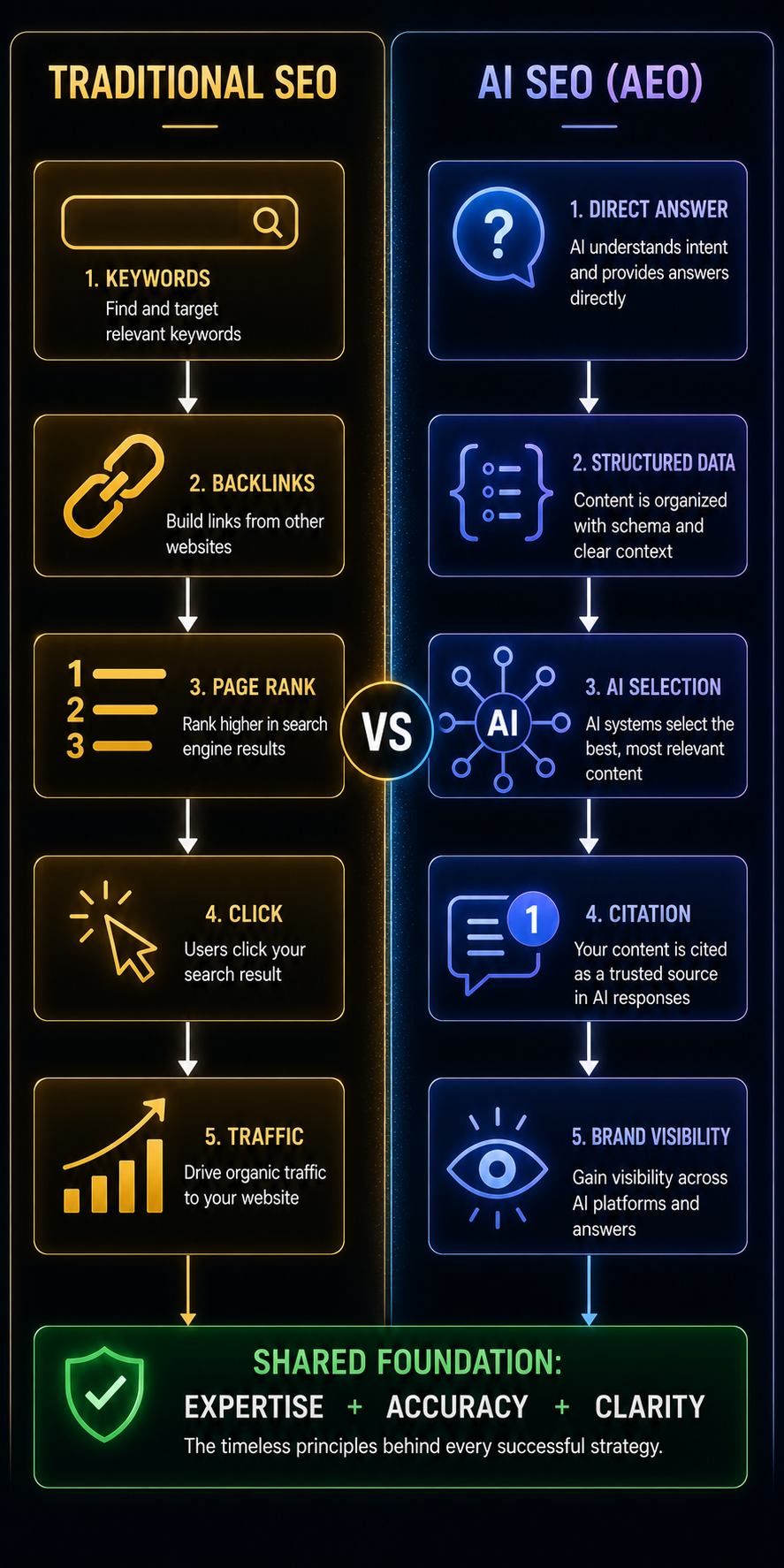
What AI SEO Actually Is
AI SEO — often called Answer Engine Optimization or AEO — is the practice of structuring content so AI systems can extract, summarize, and cite it accurately when generating answers to user queries.
The fundamental shift is from ranking to selection. Traditional SEO competes for position in a list a human scans. AI SEO competes to be the specific source an AI model chooses to base its answer on — often the only source the user ever sees represented, compressed into a sentence or two within a generated response.
How AI Systems Actually Select Sources
Google AI Overview generates a synthesized answer at the top of search results, drawing on multiple sources and often citing 3 to 8 of them directly below the generated text. Appearing in this citation list requires your content to clearly and directly answer the underlying query in extractable form.
ChatGPT, Claude, and Gemini (when using web search/browsing capabilities) search the web in response to a query, then synthesize an answer — sometimes with citations, sometimes without, depending on the specific interface. Being selected as a source requires your content to be both findable through search and clearly structured enough to extract confidently.
Perplexity is built entirely around search-and-cite — every response includes numbered citations to the specific sources it drew from. This makes Perplexity the most transparent of the AI search tools about exactly what content gets selected and why.
What Makes Content AI-Extractable
The single most important AI SEO principle: AI systems favor content that answers a specific question directly, in a self-contained way, near the beginning of the relevant section — rather than content that builds toward an answer through extended narrative or requires reading multiple paragraphs to extract the actual point.
This is a meaningfully different writing approach from much of what worked for traditional SEO, where comprehensive narrative depth and extended engagement were rewarded.
AI SEO vs Traditional SEO — Direct Comparison
| Factor | Traditional SEO | AI SEO (AEO) |
|---|---|---|
| Primary goal | Rank high in search results list | Be selected and cited by AI answer |
| Success metric | Click-through rate, ranking position | Citation frequency, answer accuracy |
| Content structure | Comprehensive narrative, deep pages | Direct answers, extractable chunks |
| Keyword approach | Density and placement optimization | Natural language matching query intent |
| Backlinks | Primary authority signal | Secondary — supports overall domain trust |
| Content format | Long-form prose, storytelling | Definitions, lists, structured data, Q&A |
| Update frequency | Periodic refresh for rankings | Continuous accuracy matters more |
| Page experience | Time on page valued | Often answered without a click at all |
| Technical priority | Page speed, mobile, crawlability | Structured data, schema markup, clarity |
| Authority signal | Domain authority, link profile | Demonstrated expertise, specific facts |
| Writing style | Can build toward conclusion | Must front-load the direct answer |
| Traffic outcome | Click to your site | Sometimes zero-click — citation only |
Related articles
AI Tools
ChatGPT vs Perplexity for Research: Which AI Is Better in 2026?
ChatGPT vs Perplexity for research — honest comparison covering accuracy, sources, real-time data, depth, use cases, and which AI research tool actually saves more time in 2026.
AI Tools
Claude Fable 5 vs Claude Opus: Which Anthropic Model Should You Use?
Claude Fable 5 vs Claude Opus — complete comparison of Anthropic's AI models in 2026. Benchmarks, capabilities, pricing, safety features, and which model is right for your use case.
What Stayed the Same — The Shared Foundation
Despite the differences, AI SEO and traditional SEO share a core foundation that has not changed and will not change regardless of how search evolves further.
Genuine expertise still wins. Both systems ultimately reward content created by people who actually understand the topic, with real experience and specific knowledge — not generic, derivative restatements of what already exists online. Google's EEAT framework (Experience, Expertise, Authoritativeness, Trustworthiness) applies to both traditional rankings and AI source selection.
Accuracy is non-negotiable. Factually incorrect content fails in both systems. Traditional SEO eventually penalizes inaccurate content through user behavior signals and competitive displacement. AI systems actively avoid citing sources that contain detectable errors or that conflict with consensus information from multiple sources.
Clear writing outperforms confusing writing. Content that is genuinely difficult to understand fails to rank traditionally and fails to be extracted accurately by AI — for exactly the same underlying reason: confusion is a quality signal in both systems, just measured differently.
Comprehensive topic coverage builds authority. A website that thoroughly covers a topic area across multiple interconnected pieces of content builds topical authority that benefits both traditional rankings and AI citation likelihood. This is precisely why building a content cluster around a subject — the way this article links to related pieces below — strengthens performance in both systems simultaneously.
Technical foundations remain necessary. A page that AI systems and Google's crawlers cannot properly access, parse, or load quickly fails in both systems before content quality even becomes a factor.
What Changed — The Critical Differences
From Keyword Density to Natural Language Precision
Traditional SEO historically rewarded strategic keyword placement and density — using your target phrase in the title, the first paragraph, several H2s, and throughout the body at a calculated frequency.
AI systems process language semantically rather than counting keyword occurrences. They match the meaning and intent of a query against the meaning and intent of your content, not the literal string match. Content stuffed with exact-match keyword repetition often reads as less natural and less confidently extractable than content using varied, natural language that genuinely covers the concept thoroughly.
Practical implication: Write for the actual question being asked, using the natural language a person would use to ask it — not the keyword phrase optimized for search volume. Include semantic variations and related concepts rather than repeating one exact phrase.
From Extended Narrative to Front-Loaded Answers
Traditional long-form SEO content often built toward its key point through extended introduction, context-setting, and narrative development — a structure that increased time on page and demonstrated depth.
AI systems extract the most direct, clearly-stated answer available — typically favoring content where the specific answer appears clearly and early within the relevant section, rather than content where the reader must follow an extended argument to reach the conclusion.
Practical implication: Open each section with a direct, extractable answer to the question that section addresses. Build supporting depth and nuance after the direct answer — not before it. This article uses this structure throughout: the Quick Answer at the top, then direct definitional statements opening each major section.
From Backlinks to Demonstrated Specificity
Backlinks remain a meaningful trust signal for both systems, but their relative weight has shifted. Traditional SEO often rewarded content with strong backlink profiles even when the content itself was relatively generic, because the link signal carried significant weight independently.
AI systems weight the specificity and demonstrable accuracy of the content itself more heavily relative to its backlink profile. A page with fewer backlinks but highly specific, accurate, well-structured information can be selected as an AI citation source over a page with stronger backlinks but more generic content.
Practical implication: Specific facts, real statistics with context, concrete examples, and named details (not "many experts believe" but actual attributed claims) increase AI citation likelihood independent of your backlink profile.
From Page Visits to Zero-Click Citations
The most structurally significant change: traditional SEO success was always measured by clicks to your site. AI SEO success is sometimes measured by citation without any click at all — your content gets used, your information reaches the user, but no traffic arrives at your website.
This is a genuinely uncomfortable shift for publishers whose business models depend on traffic. It is also an unavoidable reality of how AI Overview and AI assistants currently function.
Practical implication: Brand visibility and authority-building value exist even in zero-click scenarios — being the cited source for millions of AI-generated answers builds brand recognition and trust even without direct traffic. But content strategy now needs additional traffic-capture mechanisms — strong calls to action, content that requires deeper engagement than a single fact can provide, and offerings that an AI summary cannot fully replace (tools, calculators, personalized advice, community).
From Schema as Nice-to-Have to Schema as Essential
Structured data markup (Schema.org) was historically a moderate-priority technical SEO enhancement that improved rich snippet appearance in search results.
For AI systems, structured data has become significantly more important because it provides explicit, unambiguous signals about what your content means — definitions, FAQ pairs, how-to steps, product information — removing the ambiguity that AI systems must otherwise resolve through language interpretation alone.
Practical implication: FAQPage schema, HowTo schema, and Article schema with clear author and date information should be considered baseline requirements rather than optional enhancements for any content competing for AI citation.
The Seven Practices That Win in Both Systems
1. Open with a Direct Answer
Every page, and ideally every major section, should open by directly answering its core question in the first sentence or two — before context, before backstory, before building an argument.
This serves traditional SEO's featured snippet optimization and AI SEO's extraction requirements simultaneously. A "Quick Answer" box at the top of long-form content — like the one at the start of this article — captures both opportunities at once.
2. Use Question-Based Headings
Headings phrased as the actual questions people ask — "What is AI SEO?" rather than "Understanding AI SEO" — perform better in both systems. Traditional SEO benefits from the natural keyword match. AI SEO benefits because the heading itself becomes a clean question-answer extraction point.
Related articles
AI Tools
12 Best AI Tools for YouTube Automation in 2026 (Complete Guide)
Discover the 12 best AI tools for YouTube automation in 2026. Ranked by category — scripts, voiceover, editing, thumbnails, SEO, Shorts, and analytics. Save 10+ hours per video.
AI Tools
Sora AI Video Generator Review 2026: Is It Worth It?
Sora AI video generator honest review 2026 — we tested every feature, free plan, video quality, limitations, pricing, and real-world use cases. Find out if Sora is worth using.
3. Build Comprehensive FAQ Sections
FAQ sections serve double duty: they capture long-tail traditional search queries that would otherwise require separate pages, and they provide AI systems with clearly bounded, directly-answering content blocks that are exceptionally easy to extract and cite accurately.
Mark up FAQ content with FAQPage schema to maximize both rich snippet eligibility and AI parsing clarity.
4. Include Specific, Verifiable Facts
Generic statements ("AI is changing how people search") perform worse in both systems than specific claims ("Google AI Overview appears in a significant percentage of search results as of 2026, often without requiring users to click through"). Specificity signals genuine expertise to human readers, traditional algorithms, and AI extraction systems alike.
5. Structure Comparisons as Tables
When content compares options — products, strategies, tools, approaches — present the comparison as an actual table rather than prose description. Tables are easily parsed by both traditional search (table-based featured snippets) and AI systems (structured data extraction), and they are also genuinely more useful to human readers.
6. Build Topic Clusters, Not Isolated Pages
A single comprehensive article competing alone against the entire internet for a competitive topic struggles in both systems. A cluster of interconnected, internally-linked content covering a topic area comprehensively builds the topical authority signal that both Google's ranking algorithm and AI systems' source-credibility assessment reward.
This article exists within exactly this kind of cluster — connected to the complete AI SEO guide and the broader collection of AI tool and strategy content on this site, each reinforcing the others' topical authority.
7. Keep Content Current
Both systems penalize stale, outdated content — but AI systems are particularly sensitive to this because citing outdated information as current fact is a direct accuracy failure that damages the AI system's credibility, not just the publisher's. Regular content audits and updates matter more under AI SEO than they did under traditional SEO alone.
Common AI SEO Mistakes
Treating AI SEO as a replacement for traditional SEO. AI SEO does not replace the need for solid traditional SEO fundamentals — page speed, mobile optimization, backlinks, and keyword research all remain relevant. AI SEO is an additional layer of optimization, not a substitute.
Sacrificing readability for AI extraction. Some content creators have started writing in unnaturally fragmented, robotic patterns attempting to game AI extraction. This typically backfires — both human readers and AI systems respond better to naturally written, clearly structured content than to mechanically chunked text optimized purely for parsing.
Ignoring schema markup. Many publishers still treat structured data as optional. In 2026, FAQPage, HowTo, and Article schema with proper author and publication date information are foundational requirements for competing in AI search visibility.
Over-optimizing for zero-click outcomes at the expense of business goals. If your business model depends on website traffic and ad revenue, optimizing purely for AI citation visibility without traffic-capture strategy can actively hurt your business even while building brand visibility. Balance both objectives deliberately.
Assuming AI citation guarantees brand recognition. Many AI-generated answers do not name the source within the visible response text, particularly outside of Perplexity's explicit citation format. Citation in the background source list is valuable for some purposes but should not be assumed to deliver the same brand awareness as a clicked, visited webpage.
How to Audit Your Content for AI SEO Readiness
Run this assessment on your existing high-value content:
Does it answer its core question in the first 2 sentences of the relevant section? If the answer requires reading multiple paragraphs to extract, restructure to front-load it.
Is there a clear, scannable structure with descriptive headings? Walls of unstructured text are difficult for both human skimmers and AI extraction systems.
Does it include specific facts, figures, and named details rather than generalizations? Specificity is the clearest signal of genuine expertise to both systems.
Is structured data (schema markup) implemented correctly? Use Google's Rich Results Test to verify your schema markup renders correctly.
Does it link to and from related content on your site? Isolated pages without topical cluster support underperform connected content in both systems.
Is the information current and accurate as of today? Stale facts, outdated statistics, and superseded information actively damage AI citation reliability.
Would a featured snippet or AI Overview be able to lift a clean, accurate answer from this content? If you cannot identify the exact sentence or two an AI would extract, your content needs restructuring.
For practical guidance on implementing these principles across your content, read the complete AI SEO guide, which covers the technical implementation details in depth.
Expert Tips for Winning Both Systems Simultaneously
Tip 1 — Write the Quick Answer last, after you have written the full piece. Once you understand your own argument fully, you can compress it into the cleanest possible direct-answer format. Writing the summary first often produces a vaguer, less specific extraction target.
Tip 2 — Test your content by asking the question to ChatGPT, Perplexity, and Google directly. See what currently gets returned, identify gaps in the existing answers, and build content that fills those specific gaps rather than restating what already ranks well.
Tip 3 — Treat your FAQ section as primary content, not an afterthought. A well-built FAQ section addressing the actual specific questions people ask about your topic frequently outperforms the main article body for both featured snippets and AI citation.
Tip 4 — Use real numbers wherever genuinely possible. Even directional statistics with appropriate context ("research consistently shows," "industry data suggests") perform better than vague qualitative claims, as long as you avoid inventing false precision you cannot support.
Tip 5 — Monitor your AI citation visibility directly. Periodically search your target topics in Perplexity, ask ChatGPT and Claude directly, and check Google for AI Overview appearances. This is the only way to know whether your AI SEO efforts are actually working, since standard analytics tools do not yet reliably track AI citation traffic.
The Future of AI SEO
The trajectory over the next 12 to 24 months points toward several developments worth preparing for now:
AI Overview coverage will expand further across more query types, meaning an increasing share of search volume will be answered without a click for an increasing range of topics, not just the simple factual queries it currently handles well.
AI search tools will increasingly compete directly with Google as primary research destinations for specific use cases — meaning optimizing exclusively for Google's ranking algorithm while ignoring how Perplexity, ChatGPT, and Claude select sources will become an increasingly costly oversight.
Structured data and schema markup will continue increasing in importance as AI systems become more sophisticated about using explicit structured signals rather than relying purely on language model interpretation of unstructured content.
Brand-level authority will matter more than individual page authority as AI systems increasingly assess source credibility based on overall domain reputation and demonstrated expertise across a body of content, rather than evaluating each page in isolation.
The publishers and content creators who build genuine expertise, structure their content clearly for both human readers and AI extraction, and maintain accuracy and currency will continue to perform well regardless of how the specific mechanics of AI search evolve further. The fundamentals that have always mattered in SEO — genuine value, clarity, and trustworthiness — remain the foundation. The tactics for expressing those fundamentals to AI systems are what continue to evolve.
Key Takeaways
- Traditional SEO optimizes for ranking position in a list humans scan; AI SEO optimizes for selection and citation by AI systems generating direct answers
- Both disciplines share the same foundation: genuine expertise, accuracy, clarity, and comprehensive topical coverage
- The key differences are structural — AI SEO rewards front-loaded direct answers, natural language over keyword density, and structured data over pure backlink weight
- Zero-click citation is a real and growing outcome that traditional traffic-focused SEO strategy did not need to account for
- FAQ sections, schema markup, and question-based headings serve both systems simultaneously and should be considered foundational, not optional
- The most effective 2026 content strategy treats AI SEO as an additional layer on solid traditional SEO fundamentals — not a replacement for them
Frequently Asked Questions
What is AI SEO? AI SEO, also called Answer Engine Optimization (AEO), is the practice of structuring content so AI systems like Google AI Overview, ChatGPT, Claude, Perplexity, and Gemini can accurately extract, summarize, and cite it when generating answers to user queries. Unlike traditional SEO's goal of ranking position, AI SEO's goal is being selected as a trusted source for AI-generated answers.
Related articles
AI Tools
How to Start a Faceless YouTube Channel with AI in 2026 (Complete Guide)
Learn exactly how to start a faceless YouTube channel with AI in 2026. Complete step-by-step guide covering niche selection, script writing, AI voiceover, video editing, thumbnails, monetization, and growth strategy.
AI Tools
PaLM 2 vs Gemini: What Changed and Why It Matters in 2026
PaLM 2 vs Gemini — what are the key differences, which is more capable, and why Google replaced PaLM 2 with Gemini? Complete comparison with benchmarks, features, and real-world performance.
Is traditional SEO still relevant in 2026? Yes. Traditional SEO fundamentals — keyword research, backlinks, page speed, mobile optimization, and technical crawlability — remain necessary because Google's traditional search results still drive significant traffic, and many of these same fundamentals support AI citation likelihood. AI SEO is an additional layer of optimization rather than a replacement for traditional SEO practices.
How is AI SEO different from regular SEO? AI SEO prioritizes front-loaded, directly-answering content structure over extended narrative; natural language semantic matching over keyword density; and structured data clarity over pure backlink weight. Traditional SEO measures success through ranking position and click-through rate. AI SEO measures success through citation frequency, often without any click occurring at all.
Does Google AI Overview hurt SEO traffic? Google AI Overview can reduce click-through rates for queries it answers directly, since users sometimes get their answer without clicking any result. However, appearing as a cited source within AI Overview still provides brand visibility, and content optimized for AI Overview citation often also performs better in traditional rankings due to the shared emphasis on clear, directly-answering, well-structured content.
What is Answer Engine Optimization (AEO)? Answer Engine Optimization is another term for AI SEO — the practice of optimizing content specifically to be selected, extracted, and cited accurately by AI-powered answer engines including Google AI Overview, ChatGPT, Perplexity, Claude, and Gemini, as distinct from traditional search engine optimization focused purely on ranking position.
How do I optimize my website for AI search engines? Structure content to answer specific questions directly and early in each section, implement FAQPage and Article schema markup, include specific verifiable facts rather than generalizations, build comprehensive topic clusters with internal linking, maintain content accuracy and currency, and test your content's visibility by directly querying ChatGPT, Perplexity, and Google AI Overview for your target topics.
Will AI search replace Google? AI search tools like Perplexity, ChatGPT, and Claude are increasingly used as primary research destinations for specific types of queries, but Google continues to dominate overall search volume, and Google's own AI Overview integrates AI-generated answers directly into traditional search results rather than replacing the search engine itself. The more accurate framing is that search has become a multi-platform discipline rather than a single-destination one.
Conclusion
AI SEO and traditional SEO are not competing strategies fighting for your limited attention and resources. They are two expressions of the same underlying goal — being the most trusted, clearest, most genuinely useful source of information on your topic — measured through different mechanics in different systems.
The content that wins in both worlds shares the same DNA: genuine expertise, specific and verifiable facts, clear structure, and direct answers to real questions people actually ask. The tactical differences — front-loading answers, building FAQ sections, implementing schema markup, writing in natural language rather than keyword-stuffed phrases — are refinements on that foundation, not a different foundation entirely.
Build content that genuinely answers the question better than anything else available, structure it clearly for both human readers and machine extraction, and keep it current. Do that consistently, and you will perform well in Google's traditional rankings, in AI Overview citations, and in the growing universe of AI assistants that millions of people now turn to before they ever open a traditional search engine.
For more on building a complete AI-search-ready content strategy, read the complete AI SEO guide, the ChatGPT vs Perplexity for research comparison, the complete prompt engineering guide, and the best AI tools for digital marketing guide for the tools and strategies that support both traditional and AI search visibility.