On June 9, 2026, Anthropic released Claude Fable 5 — and the AI landscape shifted again.
Fable 5 is not a routine model update. It is the first publicly available version of Anthropic's Mythos-class technology — a tier of AI capability that the company previously considered too powerful and too risky to release broadly. For months, Mythos existed only behind closed doors under Project Glasswing, available to a handful of trusted organizations working on critical infrastructure. The fact that Anthropic felt confident enough to release a Mythos-class model for general use tells you something significant about both the capability and the safeguards involved.
Against this backdrop, Claude Opus — previously Anthropic's most capable publicly available model — faces a genuine successor for the first time. The question is not just which model is more powerful. It is which model is right for your specific use case, your budget, and your workflow.
This comparison covers everything: what changed architecturally, how the models perform across real tasks, the pricing difference, the safety implications, and who should be using which model in 2026.
Quick Answer
What is the difference between Claude Fable 5 and Claude Opus? Claude Fable 5 is Anthropic's newest frontier model — released June 9, 2026 — representing Mythos-class capability made publicly available for the first time. It outperforms Claude Opus on virtually every benchmark including coding, knowledge work, vision, and long-horizon task completion. Claude Opus 4.8 remains Anthropic's safety fallback model — Fable 5 automatically routes to Opus 4.8 for queries involving cybersecurity and biology flagged by its safety classifiers. For most demanding professional and enterprise tasks, Claude Fable 5 is significantly more capable. Claude Opus 4.8 remains relevant as the safety-gated fallback and for users on plans without Fable 5 access.
What Is Claude Fable 5?
Claude Fable 5 is a Mythos-class model that Anthropic has made safe for general use. Its capabilities exceed those of any model Anthropic has ever made generally available. It is state-of-the-art on nearly all tested benchmarks of AI capability, showing exceptional performance in software engineering, knowledge work, vision, scientific research, and many other areas. The longer and more complex the task, the larger Fable 5's lead over other models.
Fable 5 is the first publicly available version of Anthropic's Mythos model. It was launched as a preview in April, initially limited to a handful of partners due to cybersecurity concerns. Last week, Anthropic expanded access to hundreds of organizations across 15 countries, focusing on organizations that manage critical infrastructure.
The name "Fable" represents Anthropic's fifth model generation. The Mythos designation — shared with Claude Mythos 5, which remains in limited availability through Project Glasswing — signals that Fable 5 operates at a capability tier that Anthropic previously reserved for controlled deployment only.
What Makes Fable 5 Different from Previous Claude Models
Teams can hand off large projects and review completed work rather than supervising every step. Claude Fable 5 understands diagrams, charts, and tables nested in files and PDFs, improving work across document-heavy work in finance, legal, analytics, and architecture. The model also uses vision to help evaluate its own coding work, checking outputs against the original design or goal.
Three capabilities define what makes Fable 5 genuinely new rather than incrementally better:
Extended autonomous task completion. Previous Claude models could assist with complex tasks in conversation. Fable 5 can sustain complex, multi-step work over extended timeframes — handling tasks that would previously require continuous human supervision at each step.
Vision-integrated reasoning. Fable 5 does not just analyze images — it uses visual understanding as part of its reasoning process. When evaluating code it has written, it checks the output visually against the original specification. When working with documents, it understands the spatial and visual layout, not just extracted text.
Document intelligence at depth. Charts, tables, and diagrams embedded within PDFs and complex documents are processed with genuine understanding rather than text extraction approximations.
What Is Claude Opus?
Claude Opus has been Anthropic's flagship capability model through 2024 and 2025 — the model recommended for the most demanding tasks requiring the highest reasoning quality, most careful instruction following, and deepest document analysis.
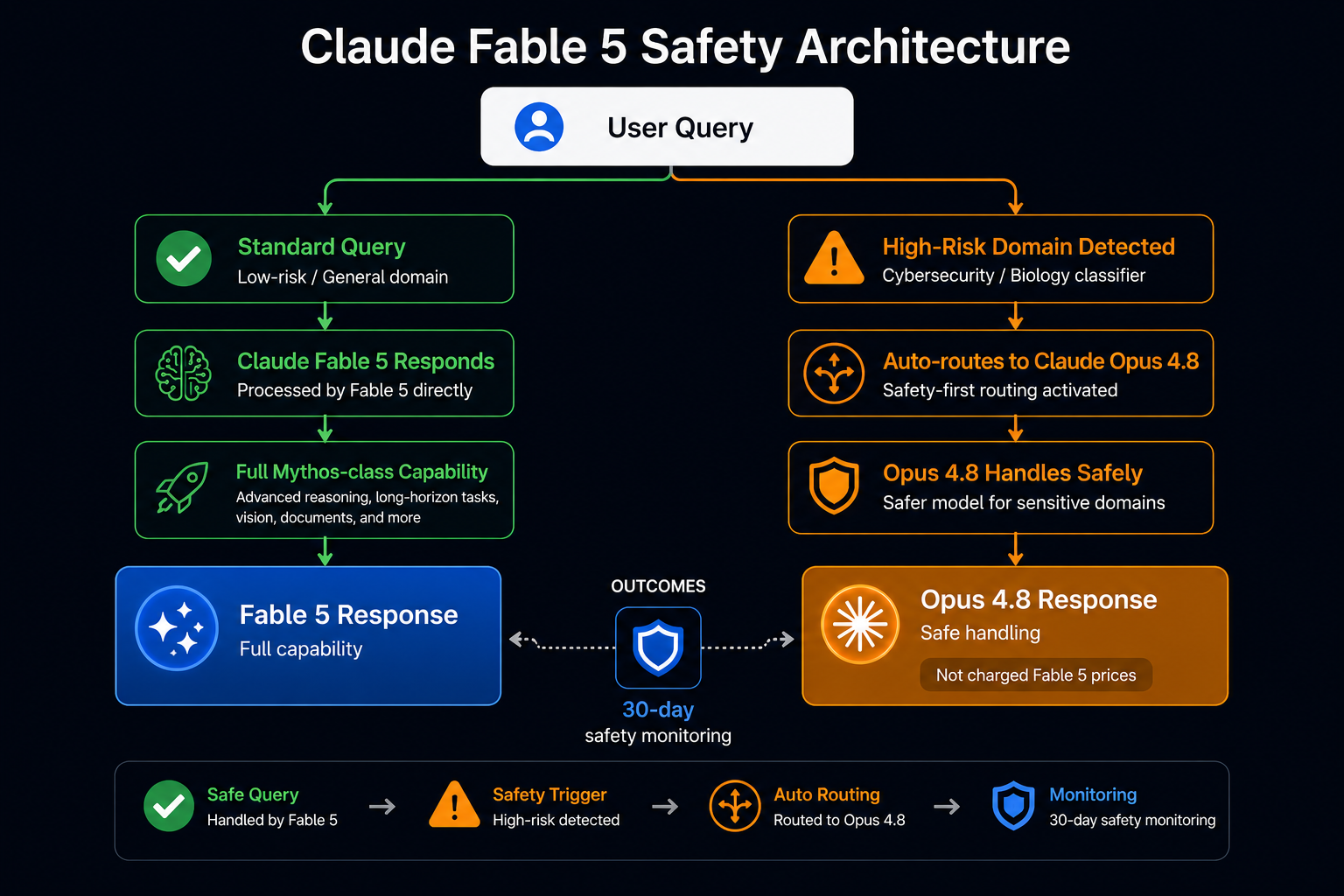
Claude Fable 5 includes robust safeguards for cybersecurity and biology. Queries in these domains are automatically routed to Opus 4.8 if flagged by these safeguards. You won't be charged Fable prices for rerouted requests.
This routing architecture reveals something important about how Anthropic positions the two models. Opus 4.8 is not being deprecated — it is being elevated to a specific safety-critical role where Fable 5's expanded capabilities are deliberately constrained.
For most users in most use cases, Fable 5 is the more capable model. For use cases that touch Fable 5's safety boundaries — certain cybersecurity research, certain biological science queries — Opus 4.8 provides the response without the capability ceiling that Fable 5's classifiers impose.
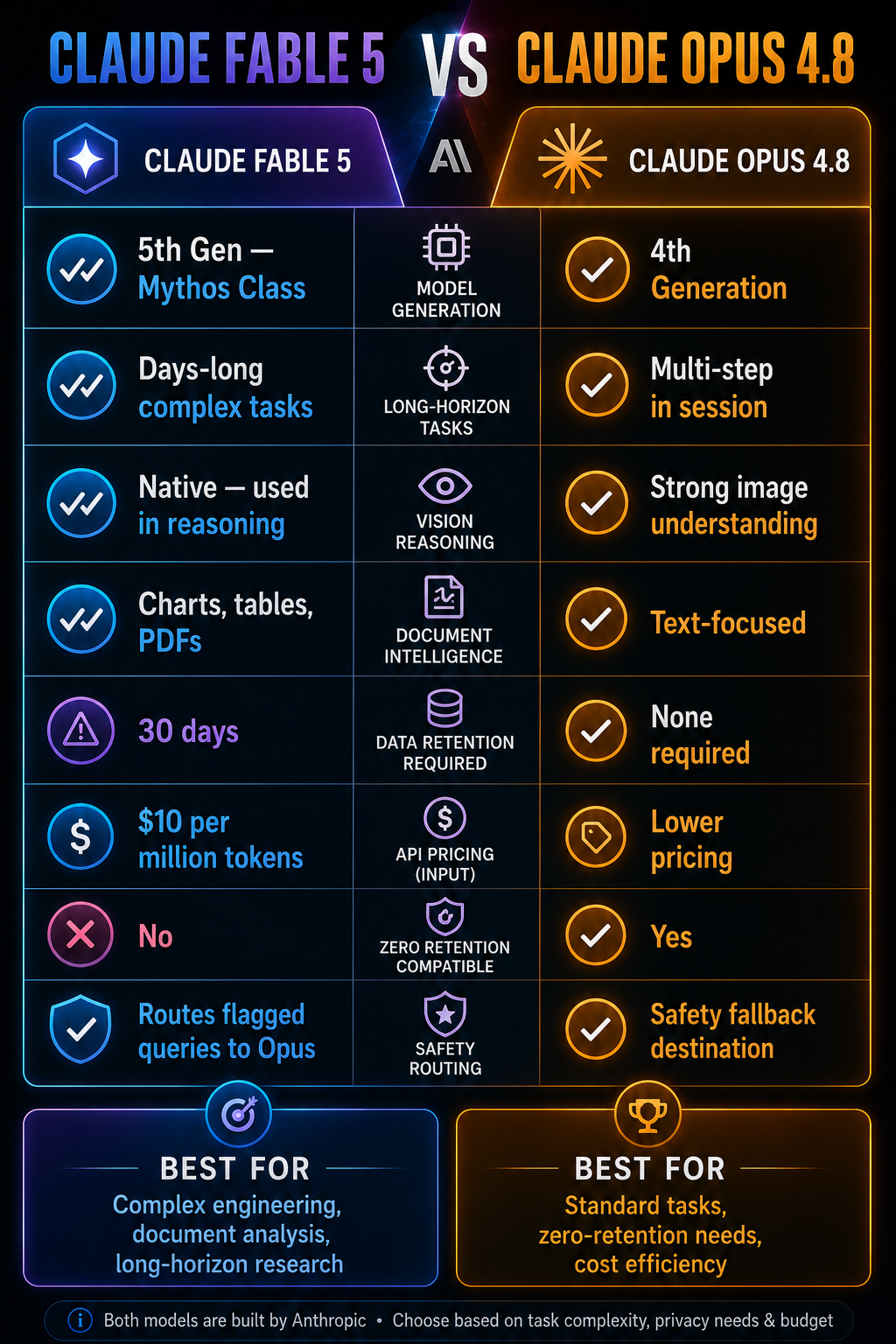
Claude Fable 5 vs Claude Opus — Direct Comparison
Architecture and Capability
| Feature | Claude Fable 5 | Claude Opus 4.8 |
|---|---|---|
| Model generation | 5th generation — Mythos class | 4th generation |
| Benchmark performance | State-of-the-art across nearly all tested | Strong — previous frontier |
| Long-horizon tasks | Days-long complex tasks | Multi-step within session |
| Vision capability | Native — used in reasoning process | Strong image understanding |
| Document intelligence | Charts, tables, diagrams in PDFs | Text-focused document analysis |
| Code evaluation | Visual output checking | Code review and generation |
| Safety routing | Routes to Opus 4.8 for flagged domains | Safety fallback destination |
| Output tokens | Up to 128K | Standard context |
| Availability | Generally available | Generally available |
Performance on Key Tasks
Software Engineering
Fable 5 represents Anthropic's strongest coding model by a significant margin. The combination of extended task completion, visual output verification, and deeper codebase understanding produces qualitatively different results on complex engineering work.
For a developer asking Claude to build a complete feature — not just write a function but plan the architecture, implement across multiple files, test the output, identify issues, and iterate — Fable 5's ability to sustain that work autonomously over an extended session is a genuine capability difference, not a marginal improvement.
Related articles
AI Tools
12 Best AI Tools for YouTube Automation in 2026 (Complete Guide)
Discover the 12 best AI tools for YouTube automation in 2026. Ranked by category — scripts, voiceover, editing, thumbnails, SEO, Shorts, and analytics. Save 10+ hours per video.
AI Tools
Sora AI Video Generator Review 2026: Is It Worth It?
Sora AI video generator honest review 2026 — we tested every feature, free plan, video quality, limitations, pricing, and real-world use cases. Find out if Sora is worth using.
Claude Opus 4.8 remains an excellent coding assistant for tasks within a single conversation context. For complex multi-session or multi-day engineering projects, Fable 5's extended autonomous capability changes what is achievable.
Knowledge Work and Research
Fable 5's capabilities exceed those of any model Anthropic has ever made generally available, showing exceptional performance in software engineering, knowledge work, vision, scientific research, and many other areas.
For knowledge workers — analysts, researchers, consultants, writers — the practical difference shows up most in tasks requiring synthesis across large, complex information sets. Processing a 200-page financial report, understanding not just the text but the tables and charts embedded within it, and producing a structured analysis with specific insights and cross-references — this is where Fable 5's document intelligence produces noticeably better results than Opus.
Writing Quality
Both models produce high-quality written output. Claude Opus has been the benchmark for AI writing quality for good reason — nuanced, natural, and well-calibrated to complex instructions. Fable 5 maintains this writing quality while adding the ability to sustain coherent, consistent output across significantly longer and more complex projects.
For short-to-medium writing tasks — articles, proposals, emails, analyses — the writing quality difference is marginal. For long-horizon writing projects — complete reports, multi-chapter documents, sustained research writing — Fable 5's ability to maintain consistency and coherence over extended work sessions becomes a meaningful advantage.
Instruction Following
Claude models have consistently led competitors on multi-constraint instruction following — and Fable 5 advances this further. The accuracy with which Fable 5 follows detailed, multi-requirement prompts on the first attempt is notably higher than previous generations on complex specifications.
Safety Architecture — The Critical Difference
The safety design of Fable 5 deserves direct attention because it affects how the model behaves in ways that matter practically.
Claude Fable 5 includes robust safeguards for cybersecurity and biology. Queries in these domains are automatically routed to Opus 4.8 if flagged by these safeguards. You won't be charged Fable prices for rerouted requests.
This is not a limitation that most users will encounter in everyday use. For developers, content creators, researchers, marketers, students, and business users working on standard professional tasks — Fable 5's safety classifiers are essentially invisible.
The domains where automatic routing to Opus 4.8 occurs are specifically high-risk areas where Fable 5's enhanced capabilities could cause meaningful harm if misused — certain cybersecurity vulnerability research and certain biological science topics. For the vast majority of professional use cases, this routing never triggers.
Anthropic said it stress-tested its classifiers with jailbreak attempts before releasing Fable 5. Internally, they ran an external bug bounty that produced no universal jailbreaks in over 1,000 hours of testing, then worked with external red-teaming organizations which also failed to find universal jailbreaks.
Data retention requirement: Claude Fable 5 supports up to 128K output tokens. The model includes safety classifiers; using Fable requires 30-day data retention for safety monitoring. This is a meaningful consideration for enterprise users with strict data residency or zero-retention requirements — Fable 5 cannot be used under zero data retention policies. Claude Opus 4.8 does not carry this requirement.
Pricing Comparison
| Model | Input tokens | Output tokens | Notes |
|---|---|---|---|
| Claude Fable 5 | $10 per million | $50 per million | 90% discount for prompt caching |
| Claude Opus 4.8 | Lower | Lower | Standard Anthropic API pricing |
Claude Fable 5 is priced at $10 per million input tokens and $50 per million output tokens, with the existing 90% input token discount for prompt caching.
Fable 5 is premium-priced relative to Opus — reflecting its position as Anthropic's frontier model. For high-volume API use cases, the cost difference is significant and should be factored into the model selection decision.
The cost-benefit calculation:
For tasks where Fable 5's advanced capabilities are genuinely necessary — extended autonomous work, complex document intelligence, advanced coding projects — the performance improvement justifies the premium price.
For tasks where Opus 4.8 is sufficient — standard writing assistance, analysis within a single conversation, typical professional communication — Opus remains the more cost-efficient choice.
Subscription access: From today through June 22, Fable 5 is included on Pro, Max, Team, and seat-based Enterprise plans at no extra cost. For subscription users, Fable 5 access during this period does not carry additional cost beyond existing plan pricing.
Availability
Claude Fable 5 is generally available on the Claude API, Claude Platform on AWS, Amazon Bedrock, Vertex AI, and Microsoft Foundry. Claude Mythos 5 is not generally available — it is offered in limited availability to approved customers in Project Glasswing.
For enterprise teams on AWS, Claude Fable 5 is available on Amazon Bedrock in the US East (N. Virginia) and Europe (Stockholm) regions.
Claude Opus 4.8 remains available across all standard Anthropic API access points without the data retention requirement that Fable 5 carries.
Who Should Use Claude Fable 5?
Fable 5 Is the Right Choice For:
Software engineers and development teams working on complex projects. The combination of extended autonomous task completion and visual output verification makes Fable 5 a qualitatively different tool for serious engineering work. Building features, refactoring codebases, debugging complex issues across multiple files — Fable 5 sustains this work at a level Opus cannot match.
Financial and legal professionals working with complex documents. The document intelligence that understands charts, tables, and diagrams embedded in PDFs directly addresses the most common pain point for professionals in these fields — extracting insight from documents where the visual structure carries as much information as the text.
Research teams tackling long-horizon projects. When a task requires days rather than hours — synthesizing large bodies of literature, producing comprehensive analyses, working through complex multi-stage problems — Fable 5's extended task completion capability changes what a single AI session can accomplish.
Related articles
AI Tools
How to Start a Faceless YouTube Channel with AI in 2026 (Complete Guide)
Learn exactly how to start a faceless YouTube channel with AI in 2026. Complete step-by-step guide covering niche selection, script writing, AI voiceover, video editing, thumbnails, monetization, and growth strategy.
AI Tools
PaLM 2 vs Gemini: What Changed and Why It Matters in 2026
PaLM 2 vs Gemini — what are the key differences, which is more capable, and why Google replaced PaLM 2 with Gemini? Complete comparison with benchmarks, features, and real-world performance.
Enterprise teams that need the highest available capability. For organizations where AI performance directly affects business outcomes and cost is secondary to capability — Fable 5 is Anthropic's most capable publicly available model.
Developers building AI-powered applications. Fable 5's availability on AWS Bedrock, Vertex AI, and Microsoft Foundry makes it accessible within existing enterprise infrastructure without additional vendor relationships.
For more on how Fable 5 compares to models from other AI companies, read the GPT-5.5 vs Claude Opus comparison and the Gemini 2 vs GPT-5.5 full comparison.
Claude Opus 4.8 Is Still the Right Choice For:
Users with zero data retention requirements. Fable 5 requires 30-day data retention for its safety monitoring classifiers. Organizations with strict data handling policies — certain financial institutions, healthcare organizations, government contractors — may be unable to use Fable 5 under their compliance frameworks. Opus 4.8 remains the highest-capability option for these users.
High-volume API applications where cost efficiency matters. At $10 per million input tokens and $50 per million output tokens, Fable 5 carries a significant price premium over Opus for equivalent token volumes. Applications processing large volumes of standard professional tasks — where Opus quality is sufficient — should remain on Opus for cost efficiency.
Use cases that regularly touch Fable 5's safety boundaries. For researchers working in cybersecurity or biological sciences whose legitimate work regularly touches the domains where Fable 5 routes to Opus anyway — using Opus directly avoids the classification overhead and potential routing delays.
Existing applications built on Opus that are working well. If you have a production application performing reliably on Opus 4.8, migrating to Fable 5 requires evaluating the data retention requirement, the price difference, and whether Fable 5's additional capability is actually utilized by your specific use case. Do not migrate for the sake of using the newest model if Opus serves your needs.
What Is Claude Mythos 5 — and How Does It Relate?
Claude Fable 5 and Claude Mythos 5 both became available on June 9, 2026. Claude Fable 5 is generally available on the Claude API. Claude Mythos 5 is not generally available — it is offered in limited availability to approved customers in Project Glasswing. Customers without access to Claude Mythos 5 can use Claude Fable 5, which offers the same capabilities.
Mythos 5 and Fable 5 share the same underlying capability level — the difference is access and safety configuration. Mythos 5 is available only to organizations approved through Project Glasswing, primarily those managing critical infrastructure or conducting specific high-value research. Fable 5 makes the same capability level available to general enterprise and developer users with Anthropic's safety classifiers in place.
For the vast majority of users — developers, enterprises, professionals — Fable 5 is the accessible equivalent of Mythos 5. The capabilities are described as equivalent by Anthropic. The distinction is primarily about who can access the unrestricted version of the technology.
Real-World Use Cases — Fable 5 vs Opus in Practice
For Content Creators and Marketers
Both models produce excellent written content. For article writing, campaign strategy, email sequences, and standard marketing work — Claude Opus 4.8 is entirely sufficient and more cost-efficient at scale.
Fable 5 becomes the better choice when content work requires extended, complex projects: developing a complete brand voice guide and then applying it consistently across a large content library in one session, analyzing a competitor's complete content ecosystem from documents and reports, or producing long-form research-backed content that synthesizes multiple complex sources.
For more on AI tools for content creation, read the best AI tools for content creators guide.
For Developers and Engineers
This is where Fable 5's advantage is most pronounced. The gap between Fable 5 and Opus for complex engineering tasks is larger than in any other use case category.
Routine coding tasks — writing functions, explaining code, debugging specific errors — Opus handles these well and at lower cost. Complex project-level engineering — building complete features, refactoring significant portions of a codebase, designing system architecture and implementing it — Fable 5's extended autonomous capability and visual output verification produce meaningfully better results.
For more on AI coding tools, read the best AI coding assistants guide.
For Students and Researchers
Fable 5's document intelligence — understanding charts, tables, and embedded figures in academic papers and research documents — directly benefits academic work where the visual content in papers carries as much information as the text.
For standard research assistance, essay writing, and studying — Opus is sufficient. For literature review across many complex academic papers, analyzing research data in document form, or sustained research writing projects — Fable 5's capabilities justify the access.
For more on AI tools for academic work, read the best AI tools for students guide.
For Business Professionals and Enterprises
Financial analysts working with complex reports containing embedded tables and charts, legal professionals processing document-heavy case files, management consultants synthesizing large research libraries — these are the use cases where Fable 5's document intelligence creates the clearest practical advantage.
For standard business communication, analysis, and professional writing — Opus provides excellent results. The migration to Fable 5 makes the clearest sense when the work regularly involves the specific capability areas where Fable 5 extends beyond Opus.
How to Access Claude Fable 5
Claude.ai subscription users: Fable 5 is available on Pro, Max, Team, and Enterprise subscription plans. During the current rollout period, it is included at no additional cost to existing subscribers.
API developers:
Access Fable 5 through the Anthropic API using the model string claude-fable-5. Available directly through the Anthropic platform and through AWS Bedrock, Google Cloud Vertex AI, and Microsoft Foundry.
Enterprise users on cloud platforms: Fable 5 is available on Amazon Bedrock in US East (N. Virginia) and Europe (Stockholm) regions, with additional region availability expanding.
Important: Using Fable 5 requires accepting the 30-day data retention requirement for safety monitoring. Review your organization's data handling policies before deploying Fable 5 in production applications.
Common Questions About Claude Fable 5 vs Opus
Is Claude Fable 5 better than Claude Opus in every way? On capability benchmarks, yes — Fable 5 outperforms Opus across nearly all tested areas. However, Fable 5 requires 30-day data retention which Opus does not. For organizations with strict zero-retention policies, or for high-volume applications where Opus quality is sufficient, Opus 4.8 remains the more appropriate choice.
What is the relationship between Claude Fable 5 and Claude Mythos 5? Both were released on June 9, 2026. They share the same underlying capability level. Mythos 5 is available only to approved organizations through Project Glasswing. Fable 5 makes equivalent capabilities available to general users with safety classifiers that route high-risk queries to Opus 4.8. For most users, Fable 5 and Mythos 5 are functionally equivalent.
Why does Claude Fable 5 route some queries to Opus 4.8? Fable 5's safety classifiers automatically detect queries in specific high-risk domains — primarily certain cybersecurity and biology topics — where the model's enhanced capabilities could enable harm if misused. Detected queries are routed to Opus 4.8, which handles them under its standard capability level. Users are not charged Fable 5 prices for rerouted requests.
How much does Claude Fable 5 cost? Fable 5 is priced at $10 per million input tokens and $50 per million output tokens through the API. A 90% discount applies for prompt caching. Subscription users on Pro, Max, Team, and Enterprise plans have access included during the current rollout period.
Is Claude Fable 5 available on free plans? Currently Fable 5 access is limited to paid subscription plans (Pro, Max, Team, Enterprise) and API access. Free tier users continue to have access to Claude Sonnet and other models but not Fable 5.
What is the data retention requirement for Fable 5? Using Fable 5 requires 30-day data retention to support the safety monitoring classifiers. This means prompts and outputs are retained for 30 days. The model is not available under zero data retention policies. Organizations with strict data handling requirements should evaluate this before migrating from Opus.
Should I switch from Claude Opus to Claude Fable 5? If you are using Claude for complex coding, extended research projects, or document-heavy professional work — yes, Fable 5 offers meaningful capability improvements. If you are using Claude for standard writing, analysis, and professional communication — Opus 4.8 continues to perform excellently. If you have zero data retention requirements — stay on Opus until Anthropic addresses this limitation.
Related articles
AI Tools
10 Best AI Voice Generators in 2026 (Free and Paid, Ranked)
Discover the 10 best AI voice generators in 2026 — tested and ranked for voice quality, naturalness, languages, free plan value, and real-world use cases. Find the perfect AI voice tool.
AI Tools
How to Build a Personal Brand Using AI in 2026 (Complete Guide)
Learn how to build a powerful personal brand using AI tools in 2026. Complete step-by-step guide covering content strategy, social media, website, thought leadership, and monetization with AI.
The Bigger Picture — What Fable 5 Signals
Claude Fable 5's release is notable beyond the capability improvements themselves. It represents Anthropic's first public deployment of Mythos-class AI — a capability tier the company previously considered too risky for broad access.
The fact that Anthropic released Fable 5 with confidence in its safety architecture — after extensive red-teaming, external bug bounties, and the development of robust safety classifiers — signals a meaningful development in how the company thinks about capability and safety tradeoffs.
The automatic routing to Opus 4.8 for high-risk domains is not a limitation presented reluctantly. It is a deliberate design choice that allows Anthropic to make frontier capability broadly accessible while maintaining meaningful constraints on the specific use cases that pose the highest risk. This architecture — frontier capability with domain-specific safety routing — is likely a model for how Anthropic will approach future frontier releases.
For users and developers, the practical implication is clear: Fable 5 is the most capable publicly accessible Claude model available, made so through a safety architecture that should not materially affect the vast majority of professional use cases.
Key Takeaways
- Claude Fable 5, released June 9, 2026, is the first publicly available Mythos-class Claude model — outperforming Opus across nearly all benchmarks
- Fable 5's standout capabilities are extended autonomous task completion, vision-integrated reasoning, and deep document intelligence for charts, tables, and embedded figures in PDFs
- Claude Opus 4.8 remains Anthropic's safety fallback — Fable 5 automatically routes flagged cybersecurity and biology queries to Opus and does not charge Fable prices for rerouted requests
- Fable 5 requires 30-day data retention for safety monitoring — making it incompatible with zero data retention policies
- Pricing: $10 per million input tokens and $50 per million output tokens, with 90% prompt caching discount
- For complex coding, long-horizon research, and document-heavy professional work — Fable 5 is the clear choice
- For standard professional tasks, high-volume cost-sensitive applications, or zero-retention environments — Opus 4.8 remains the right model
Conclusion
Claude Fable 5 is a genuine capability leap — not a marketing iteration. The combination of Mythos-class intelligence, extended autonomous task completion, and document intelligence that understands visual content makes it Anthropic's most capable publicly available model by a meaningful margin.
Claude Opus 4.8 is not obsolete. Its role as Fable 5's safety fallback gives it ongoing relevance in the architecture. Its absence of data retention requirements makes it the necessary choice for compliance-sensitive environments. Its lower cost makes it the smarter choice for high-volume applications where Fable 5's advanced capabilities are not fully utilized.
The practical recommendation is straightforward: evaluate whether your specific use cases benefit from Fable 5's extended task completion, vision reasoning, and document intelligence. If they do — and for complex professional and engineering work, they likely will — migrate to Fable 5. If your use cases are well-served by Opus 4.8 and you have data retention concerns or cost efficiency priorities — stay on Opus.
The right model is the one that serves your actual work. Both are excellent. Fable 5 is more capable. Opus 4.8 is more cost-efficient and more flexible on data handling. The choice depends on which of those factors matters more for your specific situation.
For more on Anthropic's Claude models and how they compare to other frontier AI, read the ChatGPT vs Claude vs Gemini complete comparison, the GPT-5.5 vs Claude Opus detailed comparison, the Gemini 2 vs GPT-5.5 full comparison, and the best free AI tools guide for a complete picture of the 2026 AI landscape.