Your personal brand is the most valuable professional asset you can build in 2026. It determines who finds you, who trusts you, who hires you, and how much they pay you.
The problem is that building a genuinely strong personal brand — consistent content, clear positioning, visible expertise, active social presence — has historically required either significant time or significant money. Most professionals have neither in surplus.
AI has changed that calculation fundamentally. The content production, research, design, and distribution tasks that made personal branding time-prohibitive for busy professionals can now be handled faster, cheaper, and at higher volume than was possible before.
But AI-powered personal branding done wrong produces something worse than no brand at all — a generic, impersonal presence that signals you are a copy of everyone else using the same tools the same way.
This guide shows you how to build a personal brand with AI that is genuinely yours — distinctive, credible, and built to grow — not a templated approximation of what everyone else is doing.
Quick Answer
How do you build a personal brand with AI? Building a personal brand with AI involves five interconnected stages: defining your positioning and audience (human work), creating consistent content faster using AI writing tools like Claude and ChatGPT, designing professional visuals with Canva AI, distributing content systematically using scheduling tools like Buffer, and analyzing performance with AI analytics. AI handles the production — you provide the expertise, perspective, and authentic voice that makes a personal brand worth following.
What a Strong Personal Brand Actually Is
Before tactics, a definition worth internalizing.
A personal brand is not a logo, a color palette, or a posting schedule. It is the specific association that forms in someone's mind when they think of your name — what you are known for, why you are trusted, and what unique perspective you bring to your field.
The strongest personal brands in any field share three characteristics:
Specificity. They stand for something specific rather than everything generally. "Marketing expert" is not a brand. "The person who helps B2B SaaS companies fix their broken email onboarding sequences" is a brand. Specificity makes you findable, memorable, and relevant to the right people.
Consistency. The same perspective, values, and voice appear across every platform and piece of content. Consistency builds recognition — the feeling that a new piece of content is unmistakably from the same person, even before the reader sees the name.
Demonstrated expertise. Claims of expertise without evidence produce skepticism. Demonstrated expertise — content that proves you understand your subject at depth, that shows your thinking process, that helps people solve real problems — produces trust.
AI accelerates the production of all three. It does not create them for you.
Stage 1 — Define Your Brand Positioning (Human Work First)
This stage requires your thinking, not AI. Rushing to content production before positioning is clear produces a lot of content that does not build toward anything.
The Three Positioning Questions
Question 1: Who specifically do you help?
Not "professionals" or "businesses" — those are too broad to be useful. The more specific your audience definition, the more relevant your content feels to the people it is for.
Examples of specific audience definitions:
- Early-stage founders who have product-market fit but have never hired a sales team
- Freelance UX designers transitioning to in-house roles
- Small law firm partners who want to use AI tools without creating compliance risk
Question 2: What specific problem do you solve or outcome do you create?
Again — specific. Not "I help people grow their business." What specifically gets better for whom?
Question 3: What is your unique perspective or approach?
What do you believe about your field that most people in your field disagree with, underappreciate, or have not thought about? This is your point of differentiation. Without a distinctive perspective, you are adding more content to a crowded space rather than building a position within it.
Use Claude to Sharpen Your Positioning
Once you have rough answers to these three questions, use this prompt to refine them: I am building a personal brand. Here are my rough positioning answers: Who I help: [your answer] What problem I solve: [your answer] My unique perspective: [your answer] Please do these things:
Identify where my positioning is still too generic Ask me 5 questions that would help me get more specific Suggest 3 alternative positioning angles I have not considered Write a one-sentence brand positioning statement using my answers
Iterate on this until your positioning statement is specific enough that someone reading it immediately knows whether it is relevant to them — and those it is relevant to feel like it was written specifically for them.
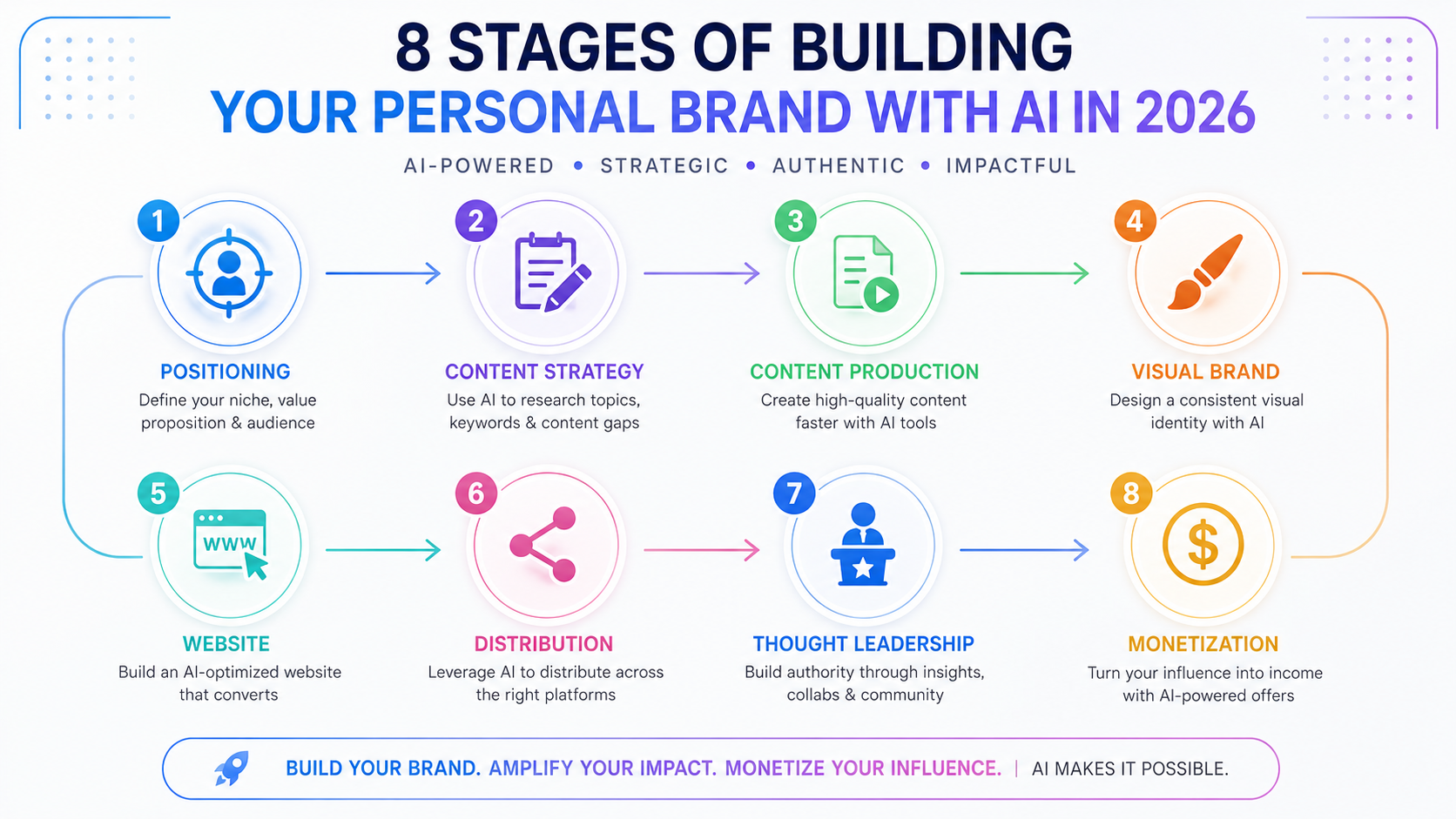
Stage 2 — Build Your Content Strategy with AI
Content is how your expertise becomes visible. Your positioning defines what you stand for. Your content demonstrates that you actually understand it at depth.
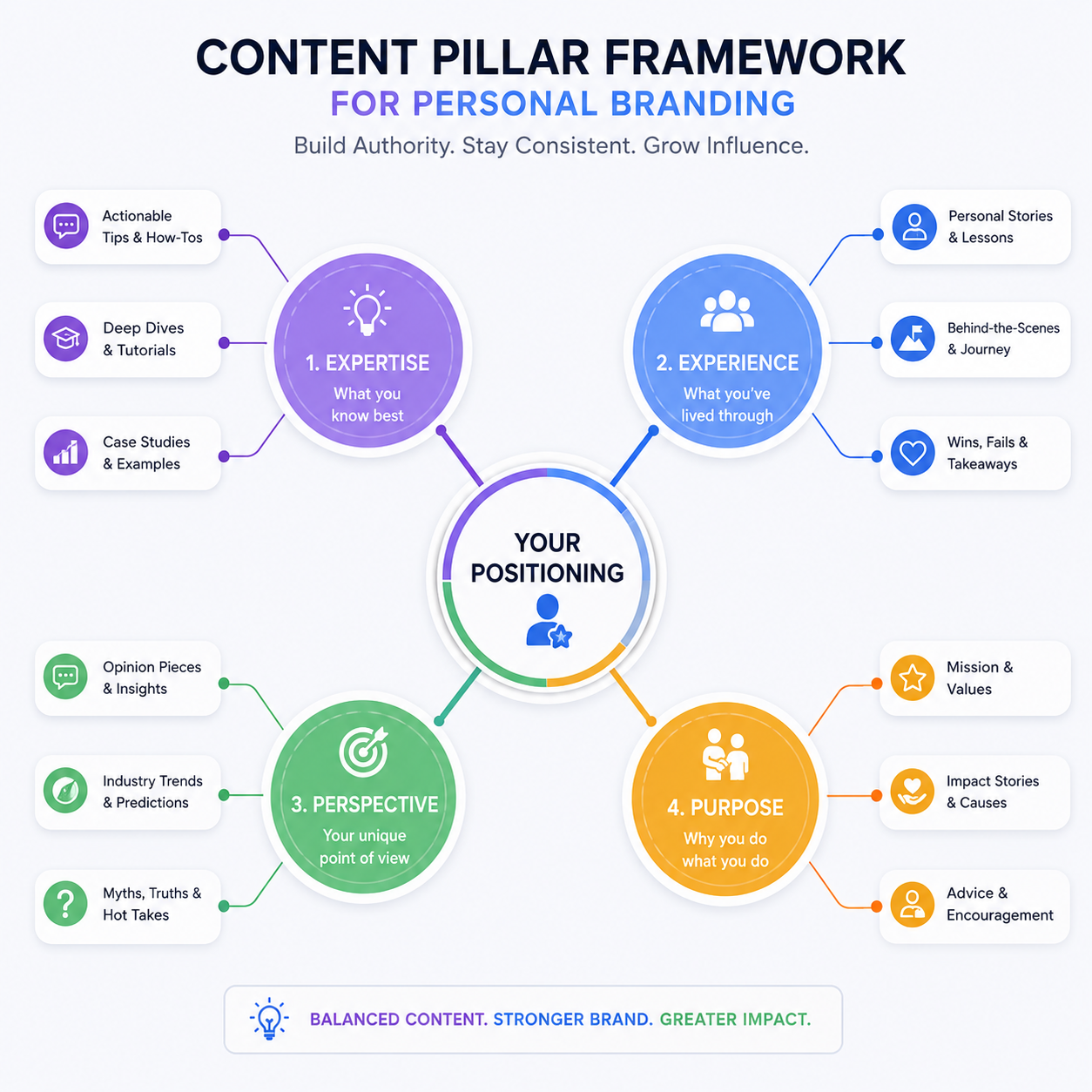
The Content Pillar Framework
Organize your content around 3 to 4 content pillars — specific topic areas that all connect back to your positioning. Every piece of content you produce fits within one of these pillars.
Use Claude to define your content pillars: My personal brand positioning is: [your one-sentence positioning] My target audience is: [specific description] My professional background includes: [relevant experience] Define 4 content pillars for my personal brand. For each pillar:
Name the pillar (2 to 3 words) Explain what specific topics and angles it covers Give 5 specific content ideas within that pillar Explain why this pillar is relevant to my target audience
The pillars should collectively cover everything my audience cares about that I have genuine expertise in.
The Content Idea Engine
Once your pillars are defined, use this workflow to generate a consistent flow of content ideas:
Weekly idea generation prompt: I create content for [your audience] about [your topic area]. My 4 content pillars are: [list them] Generate 20 content ideas for this week across all pillars. For each idea include:
The specific angle or hook (not just a topic) The format (LinkedIn post, long article, short video, thread) The emotion or outcome it creates for the reader Whether it is beginner, intermediate, or advanced level
Prioritize ideas that:
Share a specific opinion or contrarian view Tell a story that illustrates a principle Solve a specific, named problem my audience has Debunk a common misconception in my field
Content Formats That Build Personal Brand
Different content formats serve different personal branding objectives:
Long-form articles — establish depth of expertise. People who read a well-reasoned 1,500-word piece trust you more than someone who posts daily one-liners. Publish on your website or LinkedIn articles.
Short posts and threads — build awareness and top-of-mind presence. High-frequency, high-specificity short content reaches people who would never read a long article. LinkedIn posts, X threads, and Instagram carousels serve this function.
Case studies and results — convert awareness into trust. Specific stories of problems solved, approaches taken, and results achieved are the most persuasive personal brand content available. One detailed case study outperforms ten generic advice posts for building genuine credibility.
Opinions and takes — differentiate you from everyone else. The most shared personal brand content takes a specific position that some people agree with strongly and others push back on. Safe, consensus opinions produce no reaction and no sharing.
Stage 3 — Produce Content at Scale with AI
With positioning and strategy defined, AI becomes your production accelerator. Here are the specific workflows for each content type.
Writing LinkedIn Posts with AI
LinkedIn is the highest-leverage platform for most professional personal brands in 2026. The organic reach available on LinkedIn for genuinely good content exceeds every other professional platform.
The high-performing LinkedIn post formula:
Related articles
AI Tools
Claude Code vs Cursor vs Codex: Which Should You Use in 2026?
Not sure whether to pick Claude Code, Cursor, or Codex? The honest answer for most developers in 2026 is more than one. Here's how they actually differ and how to combine them.
AI Tools
Best AI Tools for Coding in 2026 (By Category, Not a Ranked List)
Best AI tools for coding in 2026, sorted by what they actually do — IDE-native tools, autocomplete, conversational assistants, and agentic coding tools — plus which combination to actually pay for.
- Hook (first line — determines whether anyone reads further)
- Setup (2 to 3 lines establishing context)
- Insight or story (the actual value)
- Takeaway or opinion (your specific perspective)
- Call to engagement (question or invitation to respond)
Claude prompt for LinkedIn posts: Write a LinkedIn post for my personal brand. My positioning: [one sentence] My audience: [specific description] Topic/angle: [specific idea from your content list] My personal experience with this topic: [brief relevant experience] My opinion on this: [your actual take] Format:
First line must create curiosity or make a specific claim Maximum 3 lines per paragraph No bullet points — flowing text only End with one question that invites genuine responses Total length: 150 to 250 words Tone: [your tone — direct/warm/analytical/conversational]
Do NOT use: "I'm excited to share", "game-changer", "leverage", "passionate about", or any other LinkedIn clichés. Write like a real person with a genuine perspective.
Generate 5 variations and select the strongest. The first draft is rarely the best. Generating multiple options takes 2 minutes and significantly improves the quality of what you publish.
Writing Long-Form Articles with AI
Long-form articles — on your website, LinkedIn, or Medium — are where personal brand authority gets built at depth. These are the pieces that get shared by people who want to be associated with good thinking.
Article production workflow:
Step 1 — Research with Perplexity: What are the most important recent developments, debates, and questions in [your topic area] right now? What are practitioners talking about that has not been covered well in mainstream content?
Step 2 — Outline with Claude: I am writing a [length] article for [your audience] about: [specific topic and angle] My unique perspective on this is: [your take] My relevant experience: [what qualifies you] Create a detailed article outline that:
Opens with a hook that challenges a common assumption Builds a clear argument from beginning to end Includes my personal perspective throughout Ends with a specific, actionable conclusion Has section headings that are interesting, not generic
Include [PERSONAL EXAMPLE] markers where I should insert my own stories and experiences.
Step 3 — Draft with Claude: Write each section individually rather than asking Claude to write the full article. Shorter, focused prompts produce better output and give you more control over the result.
Step 4 — Add your voice: Read the draft aloud. Every sentence that does not sound like something you would actually say — replace it. This step is non-negotiable. Your voice is what makes the content yours.
Creating Twitter/X Threads with AI
Threads are one of the highest-engagement content formats for building personal brand awareness on X. A strong thread can introduce you to thousands of people who have never heard of you.
Thread prompt: Write a Twitter/X thread about [specific topic]. My perspective: [your take on the topic] Target audience: [who should care about this] Format:
Tweet 1: Hook that makes someone stop scrolling (specific claim, surprising stat, or provocative question) Tweets 2 to 8: One insight per tweet, each building on the previous Each tweet: under 280 characters, one complete thought Tweet 9: Summary of the key takeaway Tweet 10: Call to action (follow, reply, share)
My relevant experience to reference: [brief context] Tone: [your preferred tone]
Stage 4 — Build Your Visual Brand with AI
Visual consistency — recognizable colors, typography, and design style — makes your content immediately identifiable across platforms. People should recognize a piece of content as yours before they read your name.
Define Your Visual Identity
Your visual brand needs three decisions:
Color palette: 2 to 3 colors used consistently. Primary color for emphasis, secondary for accents, neutral for backgrounds.
Typography style: Clean and modern, bold and strong, elegant and refined, or casual and friendly. This choice should match your brand voice.
Image style: Photography with a consistent treatment, illustrated graphics, data visualizations, or a mix — but consistent.
Use Claude to define your visual direction: I am defining my visual brand for my personal brand. My positioning: [one sentence] My audience: [description] Brands whose visual style I admire: [3 to 5 examples] Words that describe how I want to be perceived: [5 adjectives] Recommend:
A primary and secondary color palette (with hex codes) Typography direction (specific font style recommendations) Image and graphic style that fits my positioning What visual elements to avoid for my specific audience
Create Visual Content with Canva AI
Once your visual identity is defined, Canva AI handles the production:
Brand Kit setup — save your colors, fonts, and logo in Canva's Brand Kit. Every template you create automatically applies your visual identity rather than requiring manual style application.
LinkedIn banner — your LinkedIn profile banner is prime real estate that most professionals waste. Use Canva AI to generate a banner that communicates your positioning visually. Include your one-sentence positioning statement directly in the design.
Post templates — create 3 to 5 recurring post templates for your most common content types. A quote template, a tip template, a data visualization template. Canva AI generates the initial design — you save it as a template and reuse it with different content.
Profile photo enhancement — your profile photo is the first visual impression anyone has of your personal brand. Use tools like Remini or Canva's photo enhancement to ensure your existing photo is crisp and professional, or use an AI headshot generator if you need a new one.
For more on AI design tools, read the best free AI image generators guide.
Stage 5 — Build Your Personal Brand Website
Your website is the one platform you fully own and control. Social platforms change their algorithms, restrict reach, and occasionally disappear. Your website is your permanent, searchable home base on the internet.
What your personal brand website needs:
Homepage — your name, your one-sentence positioning, evidence of your expertise (articles, speaking, work), and a clear next step for visitors.
About page — your story, your specific expertise, your perspective, and what makes you different. This is where you are a human being rather than a professional category.
Content hub — your articles, posts, and any other long-form content in a searchable, browseable format.
Contact or work with me — how people who want to work with you or follow you take the next step.
For AI-powered website building, read the best AI website builders guide — Framer is the best option for personal brands that prioritize visual quality.
Use Claude to write your About page: Write an About page for my personal brand website. My name: [name] My positioning: [one sentence] My background: [relevant experience — be specific] My perspective: [what you believe about your field] Why I do this work: [genuine motivation] Who I help: [specific audience] One personal detail that makes me human: [something real] Requirements:
Written in first person Opens with something specific about my work or perspective, not with "I am a [job title]" Includes at least one specific story or example Ends with a clear invitation to connect or work together Sounds like me — conversational but credible 400 to 600 words
Stage 6 — Distribute and Schedule with AI
Creating content is only half the equation. Consistent distribution — the right content on the right platforms at the right frequency — is what builds audience over time.
Platform Selection
Personal brand building works best when you go deep on one or two platforms rather than spreading thin across everything.
LinkedIn — best for B2B professionals, consultants, coaches, executives, and anyone whose clients and opportunities come from professional relationships.
Twitter/X — best for technology, startups, media, politics, and fields where conversation and real-time engagement drive visibility.
YouTube — best for educators, coaches, and anyone whose expertise is best demonstrated through video. Highest barrier to entry, highest trust-building potential.
Instagram — best for visual-forward personal brands — designers, photographers, fitness professionals, lifestyle creators.
Newsletter — best for building a direct, owned audience that is not subject to platform algorithm changes. The most resilient personal brand asset after your website.
Related articles
AI Tools
AEO vs GEO vs SEO: What's Actually Different (2026 Guide)
AEO vs GEO vs SEO explained clearly — what each term actually means, whether they need separate strategies, and which one is still just marketing vocabulary.
AI Tools
Best AI Video Editors for YouTube in 2026 (By Channel Type)
Best AI video editors for YouTube in 2026 — sorted by channel type, not a generic ranked list. Free tiers, real limitations, and a workflow that actually works.
Build a Content Distribution System
Use Buffer for scheduling:
Connect your social accounts to Buffer's free plan (3 channels, 10 scheduled posts per channel). Batch-create your content for the week using Claude on Monday, schedule everything in Buffer, and maintain consistent posting without daily manual effort.
Batch content production workflow: Monday — Content creation session (2 hours) Use Claude to write:
3 LinkedIn posts for the week 1 longer LinkedIn article (every 2 weeks) 2 X/Twitter threads (every 2 weeks) Newsletter draft (weekly or bi-weekly)
Tuesday — Review and humanize (30 minutes) Read everything aloud Replace any AI-sounding phrases Add personal examples and references Confirm each piece sounds like you Wednesday — Schedule and design (45 minutes) Add to Buffer for the week Create any supporting graphics in Canva AI Schedule posts for optimal times
Newsletter as Personal Brand Anchor
A newsletter is the most underutilized personal brand asset for most professionals. Unlike social media where your reach depends on the platform's algorithm, your newsletter list is yours — every subscriber chose to hear from you directly.
Starting a newsletter with AI:
Use Substack (free to start) or Beehiiv (free up to 2,500 subscribers) as your platform. Start with bi-weekly publishing. Use Claude to help structure each issue: Help me write my personal brand newsletter issue. Newsletter name and positioning: [describe it] This week's main topic: [specific topic] My perspective on it: [your take] One specific thing my readers can do with this information: [actionable] Anything personal or behind-the-scenes to share: [optional] Structure:
Subject line (creates curiosity, under 50 characters) Opening hook (2 to 3 sentences — what the reader gets from this issue) Main section (400 to 600 words on the main topic) Quick takeaway (3 bullet points — most actionable insights) Closing (personal note, what is coming next issue) CTA (one thing to do, click, or reply to)
Stage 7 — Build Thought Leadership with AI
Thought leadership is the highest level of personal branding — being recognized as someone whose perspective on your field is worth seeking out, sharing, and citing.
The Thought Leadership Content Hierarchy
Level 1 — Information sharing: Curating and sharing relevant news and resources. Low differentiation — anyone can do this.
Level 2 — Explanation: Making complex topics accessible to your audience. Moderate differentiation — requires genuine understanding.
Level 3 — Opinion: Taking specific positions on field debates and developments. Higher differentiation — requires conviction and willingness to be disagreed with.
Level 4 — Original insight: Introducing frameworks, concepts, or perspectives that did not exist before you created them. Highest differentiation — requires deep expertise and original thinking.
Most personal brands plateau at Level 1 or 2. Thought leadership requires moving toward Level 3 and 4 content consistently.
Use Claude to develop your thought leadership angles: I am building thought leadership in [your field]. My core expertise: [describe specifically] My years of experience: [number] What I have observed that most people in my field get wrong: [your observation] What I believe about [specific topic] that is different from the mainstream view: [your take] Help me develop this into a thought leadership angle:
Articulate the mainstream view I am pushing back on Develop my counter-argument with supporting logic Identify what evidence or experience supports my position Suggest how to present this as original thinking rather than just contrarianism Identify 3 content pieces that could develop this thought leadership angle over time
Guest Writing and Speaking with AI
Thought leadership accelerates when your perspective appears on platforms other than your own — guest articles, podcast appearances, speaking engagements.
Use Claude to write guest article pitches: Write an email pitch for a guest article to [publication/blog]. Publication: [name and brief description of their audience] My positioning: [one sentence] Article idea I want to pitch: [specific topic and angle] Why their audience would care: [specific relevance] My credibility for writing this: [relevant experience] Requirements:
Under 200 words Opens with why this topic is relevant to their audience right now One sentence establishing my credibility Clear description of the article and what readers get from it Confident but not presumptuous tone Specific ask at the end
Stage 8 — Measure and Optimize Your Personal Brand
Building a personal brand without measuring what is working is building without feedback. AI tools make performance analysis faster — helping you identify what to do more of and what to stop.
Key Metrics to Track
| Metric | Platform | What It Tells You |
|---|---|---|
| Profile views | Brand awareness level | |
| Post impressions | All platforms | Content reach |
| Engagement rate | All platforms | Content resonance |
| Follower growth rate | All platforms | Audience building pace |
| Website visitors | Google Analytics | Total brand reach |
| Email subscribers | Newsletter platform | Owned audience size |
| Inbound opportunities | Personal tracking | Brand monetization |
Monthly Brand Audit with AI
Once per month, collect your top-performing and worst-performing content from each platform and run this analysis: Here is my personal brand performance data for the past month: Top 3 performing posts (with metrics): [paste data] Bottom 3 performing posts (with metrics): [paste data] Platform: [which platform] My content pillars: [list them] Please analyze:
What patterns do the top-performing posts share? What patterns do the low-performing posts share? What does this suggest about what my audience responds to? Which content pillar is performing best and why? Three specific changes I should make to my content strategy next month based on this data
This monthly analysis turns performance data into actionable strategy adjustments — compounding your personal brand growth over time.
Personal Brand Monetization — How It Converts to Income
A strong personal brand monetizes through multiple channels simultaneously. Here is how each channel works and how AI helps accelerate it:
Consulting and Freelance Work
The most direct monetization. When your brand clearly communicates your expertise, inbound consulting and freelance opportunities arrive without cold outreach.
AI accelerates this by: Producing the volume of content that builds visible expertise faster. Writing proposals and case studies that convert inquiries into clients.
Speaking and Media Appearances
Podcast interviews, conference speaking, and media quotes — all drive visibility and credibility simultaneously.
AI accelerates this by: Identifying speaking opportunities in your field, writing speaker bio and pitch materials, preparing talking points and research for interviews.
Digital Products
Courses, guides, templates, and frameworks — packaged versions of your expertise that sell at scale.
For a complete guide to digital product monetization, read the how to make money with AI tools guide.
AI accelerates this by: Structuring course curriculum from your expertise, writing sales page copy, generating marketing content for launches.
Sponsorships and Brand Partnerships
Once you have built a genuine audience — even a small, highly engaged one in a specific niche — brands in adjacent categories will pay to reach that audience.
AI accelerates this by: Writing sponsorship media kits, drafting partnership pitches, creating sponsored content that maintains your voice while serving the partner's objectives.
Common Personal Branding Mistakes to Avoid
Starting with tactics before positioning. Posting content before you know specifically who it is for and what it is building toward produces content that goes nowhere. Spend the time on positioning first — it changes everything that follows.
Letting AI write your opinions. Your perspective is your brand's most valuable differentiator. If you ask AI to generate your opinions on your field, you produce content that sounds like everyone else using the same AI tools. Use AI to produce your thinking — never to replace it.
Inconsistency. Personal brands build through repetition and recognition. Posting intensely for two weeks and then disappearing for a month produces no compounding benefit. Consistent moderate output outperforms sporadic intense output every time.
Optimizing for vanity metrics. Follower counts and like counts are visible but not always meaningful. Focus instead on: are the right people noticing me, are inbound opportunities increasing, is my content generating conversations with people I want to know.
Copying successful personal brands. Reverse-engineering what works for someone with a different audience, different positioning, and different personality produces content that feels inauthentic — because it is. Study what works for others as inspiration, not as a template.
Waiting until you are ready. The most common personal branding mistake is never starting because the positioning is not perfect, the website is not ready, or the content plan is not complete. Your brand builds through action and iteration — not through planning.
Expert Tips for Building a Faster, Stronger Personal Brand
Tip 1 — Niche down further than feels comfortable. Every personal brand that has achieved significant impact started with an audience definition that felt too narrow. The more specific your focus, the more relevant you feel to the people you are built for — and relevance drives sharing and word of mouth more than reach does.
Tip 2 — Document before you create. Before producing carefully crafted content, document what you are already doing and thinking. Behind-the-scenes process content, decisions you are navigating, experiments you are running — this authentic documentation builds more trust than polished advice posts.
Tip 3 — Engage more than you broadcast. Personal brands that only publish their own content without engaging with others in their space grow slowly. Comment thoughtfully on content from people your audience follows, engage genuinely with replies to your own content, and participate in conversations in your field. Engagement builds relationships that sharing alone does not.
Tip 4 — Create a signature framework. The personal brands with the highest recognition are associated with a specific, named framework or concept — something unique to them that others reference. Use Claude to help you articulate and name the frameworks implicit in how you approach your work. Named frameworks are shareable, teachable, and memorable.
Tip 5 — Build in public. Sharing your process — what you are trying, what is working, what failed — is some of the most engaging personal brand content available. People connect with honesty about the process more than polished representations of success.
For more on using AI tools effectively in all areas of your work, read the complete prompt engineering guide — better prompts produce significantly better AI-assisted content.
The Future of Personal Branding with AI
The trajectory of AI in personal branding over the next 12 to 24 months points toward capabilities that make the current tools look primitive:
AI-generated video content at scale. Creating video versions of written content — with realistic AI presenters or your own AI avatar — without filming will become standard. Personal brands that currently cannot produce video because of the time and equipment requirements will have no excuse by 2027.
Personalized content delivery. AI that produces slightly different versions of your content optimized for different segments of your audience — more technical for the experts, more accessible for the beginners — from a single source piece.
Autonomous content distribution. AI agents that monitor trending conversations in your field, identify relevant moments for your perspective, and draft timely responses for your review and approval — keeping your brand visible in real-time conversations without monitoring platforms constantly.
Related articles
AI Tools
AI SEO Checklist for Beginners (2026)
A practical AI SEO checklist for beginners in 2026 — the exact steps to get your content found by Google and cited by ChatGPT, Perplexity, and AI Overview.
AI Tools
Best AI Tools to Make Money Online in 2026 (Real Income, Real Tools)
The best AI tools to make money online in 2026 — real tools, real income models, and honest workflow advice for students, freelancers, and creators starting from zero.
The personal brands that build strong foundations now — clear positioning, genuine expertise, authentic voice, consistent presence — will be best positioned to leverage these capabilities as they arrive.
Key Takeaways
- Personal brand positioning must come before content production — clarity on who you help and what makes you different determines whether your content builds anything
- AI accelerates content production but cannot create your expertise, perspective, or authentic voice — those must come from you
- The most powerful personal brand content takes specific positions that some people disagree with — safe consensus content builds no recognition
- Consistency over time outperforms intensity in bursts — a sustainable content schedule beats an impressive month followed by silence
- Your website and newsletter are your owned assets — prioritize building these alongside social platform presence
- Measure monthly, adjust quarterly — personal brand building is an iterative process that compounds when you learn from performance data
Frequently Asked Questions
How long does it take to build a personal brand with AI? The first visible results — inbound messages, new followers in your target audience, opportunities you did not have before — typically appear within 3 to 6 months of consistent, focused personal brand building. AI accelerates the content production but does not accelerate the trust-building timeline. Audiences need to see consistent expertise demonstrated over time before they act on it.
How much does it cost to build a personal brand with AI? A complete personal brand can be built for under $50 per month using free tools (Claude free, ChatGPT free, Canva AI free, Buffer free, Substack free) plus a website hosting plan ($3 to $20/month). The main investment is time — 3 to 5 hours per week consistently.
Which platform is best for personal branding in 2026? LinkedIn delivers the highest ROI for most professional personal brands — particularly for B2B services, consulting, and career-focused goals. YouTube delivers the highest trust and deepest audience relationships but requires the most production effort. Start with one platform and go deep before adding others.
Can AI build my personal brand for me? No — and this framing misunderstands what AI does well. AI produces content faster and at higher volume. Your expertise, your perspective, your experience, and your authentic relationships are what give that content value and make it yours. A personal brand built entirely by AI produces content that feels like it was written by a robot pretending to be an expert — because it was.
How do I find my niche for personal branding? The most reliable approach: identify the intersection of what you genuinely know better than most people, what a specific group of people urgently need help with, and what you find genuinely interesting to think and talk about. The intersection of expertise, demand, and genuine interest produces sustainable, authentic personal branding rather than performed expertise in a field chosen for market size alone.
Should I use my real name or a brand name? Use your real name. Personal brands built on real names are more trustworthy, more portable across career changes, and more searchable than brand names. A brand name creates distance between you and your audience that works against the trust-building objective of personal branding.
How often should I post content for my personal brand? Quality and consistency beat frequency. One genuinely insightful post per week sustained for a year produces better personal brand results than five generic posts per week for two months followed by burnout. Use AI to make your sustainable frequency higher — not to produce more than you can maintain.
Start Building Your Personal Brand Today
The professionals who will have the strongest personal brands in 2028 started building them in 2026. The compounding effect of consistent, genuine expertise-sharing over time is the most valuable professional asset most people never build — because they wait until they feel ready, have more time, or know exactly what to say.
You already have expertise worth sharing. You already have a perspective worth expressing. The tools to produce, distribute, and amplify that expertise cost less than a gym membership and take less time than most professionals assume.
Your personal brand is the difference between your next opportunity finding you versus you competing for it. Start building it.
For more on building your online presence and income with AI, explore the best AI website builders guide, the how to make money with AI tools guide, the best AI productivity tools guide, and the complete AI SEO guide to make your personal brand content findable in both Google and AI search.