Most guides on making money with AI hand you a list of 25 tools and call it a day. You read it, feel briefly inspired, and then open three free trials before closing all of them because nobody explained how the income actually works.
This guide is different. Every tool here is paired with a specific income model, a realistic earnings range, and an honest assessment of what it actually takes to earn — not just what becomes possible in theory if everything goes perfectly.
The people earning real money with AI in 2026 are not necessarily the most technically skilled. They are the ones who picked a specific income model, learned two or three tools deeply, and executed consistently. That is the only pattern that matters.
Quick Answer
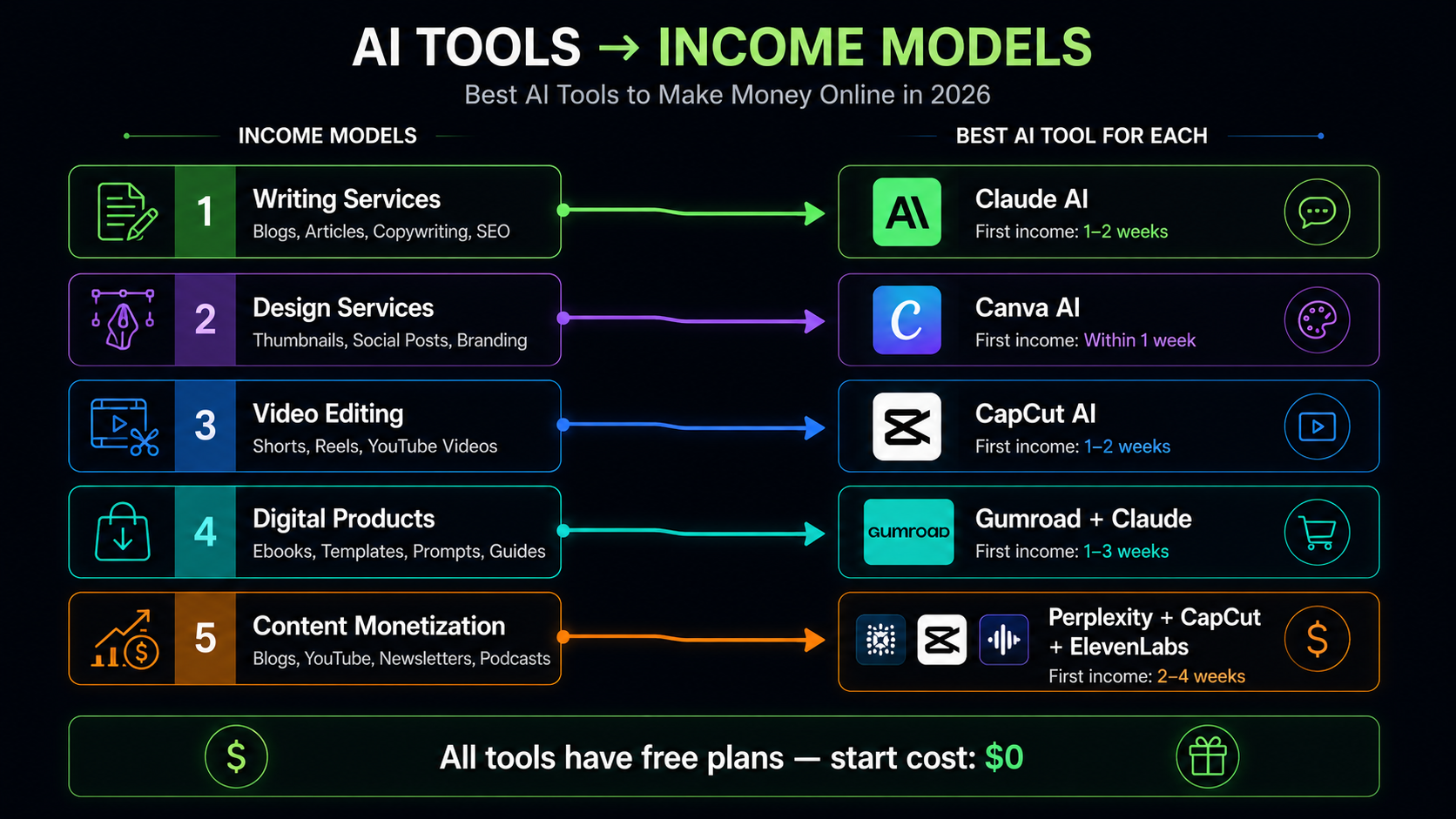
The best AI tools to make money online in 2026 are Claude and ChatGPT for content and freelance services, ElevenLabs for voiceover income, Canva AI for design services and digital products, CapCut AI for video editing services, and Gumroad paired with any AI writing tool for digital product sales. These tools cover the five income models with the lowest barrier to entry and the clearest path from first use to first payment.
The Five Income Models That Actually Work
Before the tools, the models — because the right tool depends entirely on which income approach fits your situation.
Service income — you use AI to deliver a service faster and better than someone without AI could. Writing, design, video editing, social media management. Fast to start, income tied to your active hours, but scalable through rate increases and efficiency.
Passive product income — you create a digital product once (a template, a prompt pack, a guide, a course) and sell it indefinitely. Slower to gain traction but genuinely earns while you sleep.
Content monetization — you build an audience through YouTube, a newsletter, or a blog, then monetize through advertising, affiliates, or sponsorships. Longest time to first income, highest ceiling at scale.
Affiliate income — you recommend tools and earn commission when people sign up through your link. Works best embedded inside another model (a blog, a YouTube channel) rather than as a standalone approach.
Consulting and training — you sell your AI workflow knowledge to businesses and individuals who want to use AI better but do not know how. Premium rates, requires demonstrable expertise and credibility first.
The tools below are organized by which model they serve best — not by abstract "best AI tool" rankings that ignore what you actually want to do with them.
For Service Income — The Three Tools That Matter
Claude AI — Best for Writing and Content Services
If you want to earn money selling written content — articles, email sequences, landing page copy, social media posts, ghostwritten LinkedIn content — Claude is where the workflow starts.
The income model: clients pay $75 to $300+ per piece of written content. With Claude handling first drafts and structural scaffolding, you spend your time on the highest-value parts — your subject knowledge, your editorial judgment, your ability to match a client's voice. A writer producing one article per day manually might produce two or three with AI assistance, at comparable or higher quality, because AI handles the parts that require keystrokes rather than judgment.
What makes Claude specifically valuable for writing services over other AI tools is instruction-following accuracy. When a client sends a detailed brief — specific tone requirements, forbidden phrases, mandatory sections, exact word count — Claude executes that brief more precisely on the first attempt than competing models, which matters enormously when every revision round costs you time that eats into your effective hourly rate.
The workflow that works: client sends brief → you research with Perplexity → you prompt Claude with the brief plus research → you edit, verify facts, add genuine expertise → you deliver. The edit and verification step is not optional. Clients are paying for your judgment wrapped around AI efficiency, not raw AI output.
Realistic starting income: $300 to $600 per month within 60 days of actively pursuing clients on Upwork or Fiverr, assuming 5 to 8 hours per week of work. The ceiling scales with your niche expertise and rate progression.
Canva AI — Best for Design Services and Digital Products
Canva AI sits at the intersection of two income models — service income (designing for clients) and passive product income (selling templates). That dual utility makes it the highest-leverage design tool for creators starting without a design background.
For service income: YouTube thumbnail packages, social media graphic retainers, presentation design, and brand identity packages are all services you can deliver professionally using Canva AI with no Photoshop experience required. The Brand Kit system lets you maintain each client's visual identity consistently, which is what clients are actually paying for — not raw design skill.
Related articles
AI Tools
10 Best AI Side Hustles for Students in 2026 (Make Real Money)
Discover the 10 best AI side hustles for students in 2026. Real income opportunities using free AI tools — from freelance writing to faceless YouTube, digital products, and more. Start with zero experience.
AI Tools
7 Best AI Thumbnail Generators for YouTube in 2026 (Free and Paid)
Discover the 7 best AI thumbnail generators for YouTube in 2026. Tested and ranked for design quality, ease of use, free plan value, and CTR performance. Create professional thumbnails in minutes.
For product income: Canva template stores on Etsy are a genuine passive income stream that requires understanding what buyers search for rather than what looks good to you. Resume templates, social media bundles, planner pages, and presentation decks consistently sell to buyers who want professional results without design skills. The research step — identifying what is already selling with a Bestseller badge before you create — is more important than the design step.
What Canva AI cannot do: produce the highest-quality custom backgrounds for demanding clients. For those, generate images in ChatGPT or Microsoft Designer and import them. Canva handles assembly, typography, and brand application — let other tools handle raw image generation.
CapCut AI — Best for Video Editing Services
The demand for video editing services grew significantly when short-form content became the dominant social media format. Most content creators know they need edited Shorts, Reels, and TikToks. Very few enjoy doing it themselves, and good video editors charge rates that solo creators cannot sustain.
CapCut AI automates the parts of editing that consume the most time without requiring creative judgment — auto-captions, silence removal, basic cuts, format conversion between platforms. A student or freelancer who learns CapCut's workflow can deliver edited short-form content that would cost significantly more from a traditional video editor.
The income model works as retainers rather than one-off projects. A client who pays $300/month for ten edited Shorts is worth more than a client who pays $150 for a one-time project, because recurring clients require no acquisition effort after the first sale. Target content creators and business owners who publish video regularly — they are the ones who feel the editing bottleneck acutely enough to pay someone to solve it.
Current realistic rates for student and beginner editors: $15 to $30 per short-form clip with AI assistance, rising to $40 to $75 as your turnaround speed improves and your portfolio demonstrates results.
For Passive Product Income — Two Approaches That Work
ElevenLabs — For Voiceover Products and Services
ElevenLabs sits in an unusual position on this list: it serves both service income (selling voiceover work directly to clients) and product income (using AI voiceover as production infrastructure for YouTube or course creation).
The direct service model is simpler than most people realize. Businesses producing explainer videos, e-learning modules, podcast advertisements, and corporate training content need professional voiceover consistently. Many cannot justify hiring a professional voice actor for every project. ElevenLabs' top voices produce output that meets professional standards for a large percentage of these use cases.
On Fiverr specifically, AI voiceover services are a legitimate, growing category with real client demand. The value proposition to clients is fast turnaround and consistent quality at lower cost than human voice actors for non-premium applications. Disclose that you use AI voice synthesis — platforms and clients increasingly expect this disclosure, and providing it builds trust rather than eroding it.
The product infrastructure model is where ElevenLabs has the higher long-term income ceiling. A faceless YouTube channel built on ElevenLabs narration can generate AdSense income indefinitely from every video published. A course produced with AI narration is cheaper and faster to update than one requiring re-recording sessions. These are compounding assets rather than per-project income.
The free tier provides approximately ten minutes of audio per month — enough for testing but not for production. The Starter plan unlocks meaningful production volume at a cost that pays for itself quickly once client work starts.
Gumroad + Claude — For Digital Product Sales
The combination of Claude for writing and Gumroad for selling is the lowest-friction path to passive digital product income available in 2026.
Gumroad charges no monthly fee — it takes a percentage of sales, meaning you pay nothing until you earn. Claude helps you create products that are genuinely worth buying. The operational complexity is near zero: create a product, upload it, share the link, receive payments.
The products that sell consistently on Gumroad are specific and immediately actionable: prompt packs for a specific professional use case, workflow guides for a specific AI tool, niche templates that solve a named problem for a named audience. "50 ChatGPT Prompts for Real Estate Agents" sells better than "AI Prompts for Business" because the specificity signals that the product was designed for a particular buyer rather than assembled generically.
The research step determines success more than the creation step. Browse Gumroad's marketplace, search for products in your intended niche, identify what exists and what is missing. Create the missing product — or the better version of an existing product that the reviews reveal is falling short.
Related articles
AI Tools
AI SEO vs Traditional SEO: Complete Comparison for 2026
AI SEO vs traditional SEO — complete comparison covering what changed, what stayed the same, and how to optimize content for both Google rankings and AI search engines in 2026.
AI Tools
Gemini vs ChatGPT vs Claude for Coding: Which AI is Best in 2026?
Gemini vs ChatGPT vs Claude for coding — we tested all three on real coding tasks. Honest comparison covering code quality, debugging, explanation, languages, free plans, and which AI coder wins in 2026.
One realistic expectation: a single digital product rarely generates life-changing income immediately. The creators earning meaningfully from Gumroad typically have five to fifteen products across related niches, each generating modest but consistent sales. Build a library, not a single product.
For Content Monetization — The Infrastructure Tools
Content monetization through YouTube, newsletters, or blogs takes the longest to generate income but has the highest income ceiling and the most genuinely passive returns at scale.
The AI tools that make content monetization viable without a full production team:
Perplexity AI for research — live web search with citations means you research a topic accurately in twenty minutes rather than opening fifteen browser tabs. For creators publishing multiple times per week, this research compression is where the most cumulative time is saved.
ChatGPT for ideation and metadata — generating title variations, writing SEO-optimized video descriptions, brainstorming content angles, and producing outlines quickly. The unlimited free tier on GPT-4o mini covers this use case adequately without requiring a paid subscription.
Opus Clip for Shorts repurposing — automatically extracting the best moments from long-form video content and formatting them as vertical short-form clips. For YouTube channels, this turns one long video into five to ten Shorts with minimal additional effort, multiplying the channel's weekly content output without proportional time investment.
The income from content monetization does not arrive on a predictable schedule, and the early months produce almost nothing. This is not a failure state — it is how compounding content assets work. The channels generating $2,000 to $10,000 per month in 2026 started producing nothing for three to five months before the algorithm began distributing their content at meaningful scale.
Comparison: Which Income Model Should You Start With?
| Model | Time to First Income | Weekly Hours Required | Income Ceiling | Best Starting Tool |
|---|---|---|---|---|
| Writing services | 1 to 2 weeks | 5 to 10 hrs | High (rate-dependent) | Claude |
| Design services | 1 to 2 weeks | 4 to 8 hrs | Medium-High | Canva AI |
| Video editing | 1 to 2 weeks | 5 to 10 hrs | Medium | CapCut AI |
| Digital products | 2 to 4 weeks | 3 to 5 hrs (upfront) | Medium (catalogue-dependent) | Gumroad + Claude |
| Content monetization | 3 to 6 months | 5 to 10 hrs | Very High | Perplexity + CapCut |
| Voiceover services | 1 to 2 weeks | 3 to 6 hrs | Medium | ElevenLabs |
If you need income within the next two weeks, start with services — writing, design, or video editing. If you are building toward income that compounds without proportional time investment, start building content or digital products alongside a service to fund the patience required.
The Realistic Starter Workflow — Week One to First Payment
Most guides stop at "here are the tools." Here is the actual week-one path from account creation to first paid work.
Day 1 — Choose your income model and primary tool
Pick one income model based on the comparison table above. Create accounts only for the tools that serve that model — resist the temptation to sign up for everything simultaneously. Three accounts you never use is worse than one account you use daily.
Day 2 and 3 — Build samples, not a portfolio page
You do not need a portfolio website to get first clients. You need samples of work — three pieces that demonstrate you can deliver what you are selling. Create these using your chosen AI tools. The samples should be indistinguishable from work you would deliver to a paying client, because they set the expectation.
For design and thumbnail work, create three sample pieces in the niche you are targeting. For writing, write three full articles or copy pieces. For video editing, edit three short clips from public domain or Creative Commons footage.
Day 4 — Create your first listing or proposal
On Fiverr: write a gig description that describes specifically what the buyer gets, how long it takes, and why you are the person to deliver it. Attach your samples. Price at the low end of your target range for the first five orders.
On Upwork: complete your profile fully, then write ten personalized proposals to relevant job posts — each one referencing something specific from that job description.
On Etsy: research the top-selling products in your niche, create your first product, write a listing title that matches how buyers search (not how you would describe the product), and upload.
Day 5 through 7 — Send volume
On service platforms, the first clients come from volume of activity — not from a perfect listing that sits waiting. Send proposals daily. Respond to every inquiry within an hour. Treat the first three to five clients as case study opportunities rather than income opportunities — exceptional delivery at accessible prices generates reviews that convert future inquiries at higher rates.
What Competitors Get Wrong About This Topic
Most articles on making money with AI tools either list tools abstractly without explaining how the income actually works, or they describe only the highest-ceiling opportunities (build a seven-figure agency with AI) without addressing the first hundred dollars, which is what actually separates people who build this into something from those who read about it and return to their existing routines.
The other gap: the compounding of small wins. A student who earns $150 in month one, $300 in month two, and $500 in month three from AI-assisted writing is not failing because they have not reached $5,000. They are building platform reputation, refining their workflow, and raising their rates on a trajectory that reaches meaningful monthly income within six months. The articles that focus exclusively on high-ceiling outcomes cause people to abandon legitimate progress because it does not look dramatic enough.
Frequently Asked Questions
Do I need to disclose that I use AI tools when selling services? Platform policies vary and are evolving. Fiverr and Upwork do not prohibit AI-assisted work, but many clients in certain categories — particularly those paying for unique creative voice or original research — expect disclosure. The practical approach: be transparent when asked, and in your service description make clear what you are actually delivering (your expertise, editorial judgment, and quality control, assisted by AI tools).
Which income model requires the least upfront time investment? Digital product sales on Gumroad have the lowest ongoing time commitment once the product is created — a few hours of setup and then minimal maintenance. However, building enough traffic to that product to generate consistent sales requires either a content distribution channel (which takes time to build) or paid advertising (which requires budget). Service income — writing, design, editing — generates income proportional to hours immediately and requires no audience building.
Related articles
AI Tools
How to Rank in Google AI Overviews in 2026 (Complete Guide)
Learn exactly how to rank in Google AI Overviews in 2026. Complete guide covering content structure, schema markup, E-E-A-T signals, and proven strategies to appear in Google's AI-generated answers.
AI Tools
ChatGPT vs Perplexity for Research: Which AI Is Better in 2026?
ChatGPT vs Perplexity for research — honest comparison covering accuracy, sources, real-time data, depth, use cases, and which AI research tool actually saves more time in 2026.
Can you make a full-time income from AI tools alone? Yes, and people do — but this framing understates the actual situation. The income comes from skills (writing, design, video, marketing knowledge) that AI tools amplify, not from the tools themselves. Someone with strong writing expertise and Claude as a production tool earns significantly more than someone with no writing knowledge and the same tool. AI raises the ceiling on whatever expertise you bring; it does not substitute for it entirely.
Which AI tool has the lowest learning curve for complete beginners? Canva AI for visual work and ChatGPT for writing both have the most accessible onboarding experiences. Both have free tiers that provide genuine utility from day one, and both have extensive tutorial resources. Claude is slightly more capable for complex writing tasks but the interface difference is minor.
How do taxes work when earning online with AI tools? This varies by country and is outside the scope of this guide — but the consistent principle: any income earned online is taxable income. Track every payment received from the first sale, regardless of amount. Many platforms (Fiverr, Upwork, Gumroad) provide annual income summaries for tax purposes. Consult your country's self-employment tax guidance or a local accountant before your income reaches a meaningful level.
Key Takeaways
- There is no single best AI tool to make money online — the right tool depends entirely on which income model fits your situation, timeline, and existing skills
- Service income (writing, design, video editing) generates money fastest — typically within one to two weeks of actively pursuing clients
- Passive income models (digital products, content monetization) take longer to reach first income but compound in ways that service income does not
- Claude leads for writing quality and instruction following, Canva AI for design services and template products, CapCut AI for video editing services, ElevenLabs for voiceover, and Gumroad for frictionless digital product selling
- AI tools amplify existing knowledge — someone with subject expertise earns significantly more from the same tools than someone without it
- The week-one actions that matter: choose one model, build three samples, create one listing, and send volume — not perfect — proposals or listings
For more on building online income with AI tools, read our AI side hustles guide for students, the freelancing with AI complete guide, and the prompt engineering guide — building the prompting skills that make every tool on this list work better.