Most YouTube creators are still doing things the hard way.
They spend 8 hours editing a single video. They guess what topics their audience wants. They design thumbnails that never get clicked. They upload inconsistently because production takes too long — and then wonder why their channel is not growing.
The creators growing fastest in 2026 are not necessarily the most talented. They are the ones who figured out how to combine human creativity with AI speed — cutting production time in half while producing better content more consistently than their competitors.
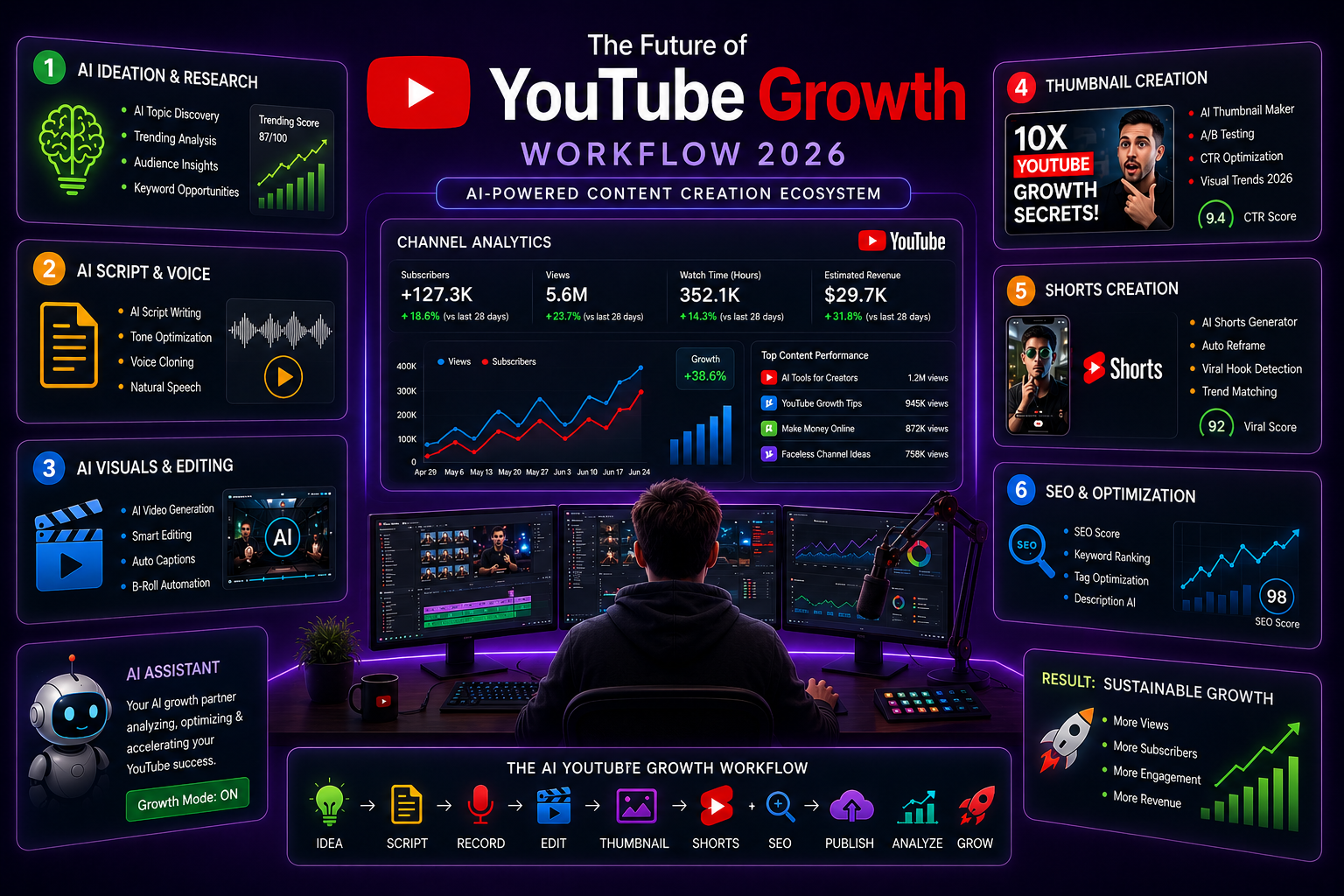
This is not about fully automated faceless channels churning out generic content. That approach worked briefly and now produces diminishing returns. This is about using AI as a force multiplier for genuine creators — making your ideas faster to execute, your content better optimized, and your workflow sustainable enough to actually stay consistent.
Here is the complete guide to growing a YouTube channel with AI in 2026 — from finding your first viral idea to building a production workflow that scales.
Quick Answer
How can AI help grow a YouTube channel?
AI accelerates YouTube growth by automating the most time-consuming parts of content creation — script writing, thumbnail design, video editing, caption generation, keyword research, Shorts repurposing, and performance analytics. Creators using AI tools produce more content, optimize it more effectively, and maintain consistency that manual workflows cannot sustain. The result is faster subscriber growth, better search visibility, and higher watch time — without burning out.
Why AI Is Transforming YouTube Growth in 2026
YouTube has always rewarded two things above everything else: consistency and quality. The problem is that quality content takes time — and time is the resource most creators run out of first.
AI changes that equation fundamentally.
The average YouTube video production workflow without AI looks like this: research takes 2 to 3 hours, scripting takes 3 to 4 hours, filming takes 2 hours, editing takes 6 to 10 hours, thumbnail creation takes 1 to 2 hours, and SEO optimization takes another hour. That is 15 to 22 hours per video for a creator working alone.
With an optimized AI workflow, the same production process takes 5 to 8 hours — with better SEO, more compelling thumbnails, and faster editing than most creators achieve manually.
The math is simple. A creator producing one video per week manually produces 52 videos per year. A creator using AI to cut production time in half produces the equivalent — at higher consistency and often higher quality — in the same hours they previously spent on 26 videos.
That compounding advantage is why channels using AI workflows are growing at rates that manual-production channels cannot match.
Best AI Tools for YouTube Creators in 2026
Before the workflow, here is your complete AI toolkit — one tool for each stage of production.
| Purpose | Best Tool | Free Plan |
|---|---|---|
| Idea research | Perplexity AI | Yes — unlimited |
| Script writing | Claude AI | Yes — daily limit |
| Script alternatives | ChatGPT | Yes — unlimited |
| Video editing | CapCut AI | Yes — fully free |
| Text-based editing | Descript | Yes — limited |
| Thumbnails | Canva AI | Yes — generous |
| Thumbnail text | Ideogram | Yes — 10/day |
| Voiceover | ElevenLabs | Yes — 10k chars/month |
| SEO research | VidIQ | Yes — basic free |
| Shorts generation | Opus Clip | Yes — limited |
| Analytics | YouTube Studio | Yes — free |
| Caption generation | CapCut AI | Yes — fully free |
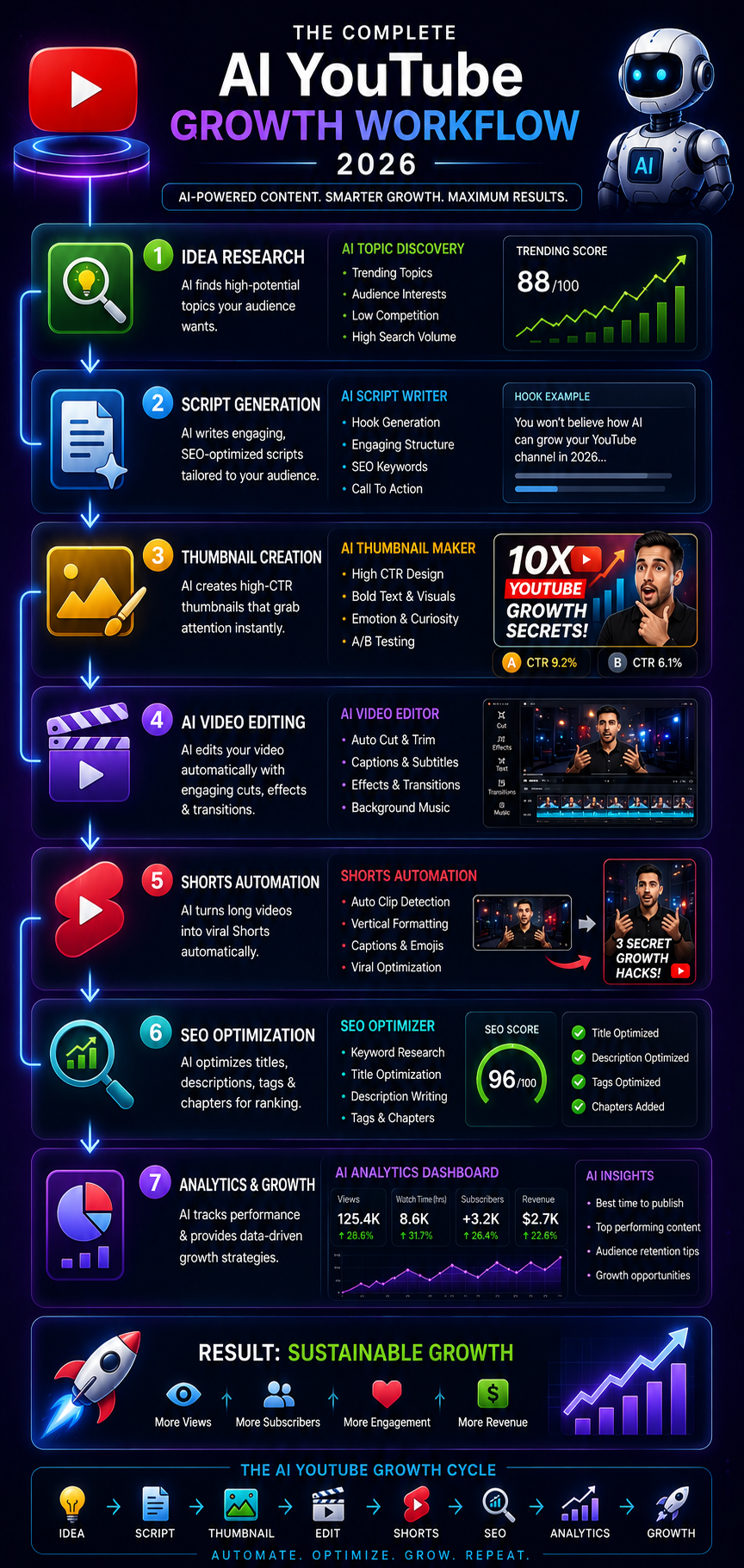
For a complete breakdown of these tools and more, read the best AI tools for content creators guide.
Step 1 — Find Viral Video Ideas with AI
The single biggest reason channels fail to grow is not poor editing or bad thumbnails. It is creating videos nobody is searching for.
Most creators choose topics based on what they personally find interesting. Successful creators choose topics based on what their target audience is actively searching for, what has high click potential, and what competitors are underserving.
AI makes that research dramatically faster.
The AI Idea Research Workflow
Start with Perplexity AI for trend identification: What are the most searched YouTube topics related to [your niche] right now? What questions are people asking that have high search volume but limited quality answers?
Perplexity searches the live web and gives you current trend data with sources — not guesses based on training data.
Then use ChatGPT for volume idea generation: Generate 30 YouTube video title ideas for [your niche]. Each title should:
Target a specific audience pain point Create genuine curiosity Be searchable on YouTube Have click-through potential Format as a numbered list.
Validate with VidIQ or TubeBuddy. Search your top 5 ideas on YouTube directly. Look for keywords with meaningful search volume and videos in results that are underperforming relative to their view count — that gap signals opportunity.
What Makes a Topic Worth Creating
Three criteria that predict whether a video will get views:
Search demand — people are actively searching for this specific topic on YouTube.
Emotional curiosity — the topic creates a question in the viewer's mind that they want answered. "AI tools" has search demand. "7 AI tools students are secretly using to save 10 hours every week" creates curiosity.
Competitive gap — the existing videos on this topic are either old, low quality, or not specifically addressing the audience you are targeting.
Expert tip: Search your topic on YouTube and sort by "Upload date." If recent videos have low view counts despite the topic being genuinely searched, either the topic has low demand or the competition gap is real and the topic is underserved. Both are useful signals.
Step 2 — Write High-Retention Scripts with AI
Script quality determines watch time. Watch time determines YouTube's algorithm decisions. This is where AI delivers the most leverage for most creators.
The mistake most creators make with AI scripting is treating it as a ghostwriter — generating the entire script and reading it word for word. This produces content that feels hollow because it lacks your specific perspective, examples, and personality.
The better approach: use AI for structure, research synthesis, and hook generation. Add your own examples, opinions, and personality in the edit.
The High-Retention Script Formula
Hook — first 15 seconds — non-negotiable:
Your hook has one job: prevent the viewer from clicking away. The first 15 seconds of every YouTube video are where most views are lost.
Use this prompt to generate hook options: Write 10 different opening hooks for a YouTube video titled "[your title]". Each hook should:
Create immediate curiosity or tension Make a specific promise or ask a provocative question Be under 30 words NOT start with "In this video" or "Today I'm going to show you" Feel like something a real person would say, not a corporate script
Related articles
AI Tools
Best AI Tools for Coding in 2026 (By Category, Not a Ranked List)
Best AI tools for coding in 2026, sorted by what they actually do — IDE-native tools, autocomplete, conversational assistants, and agentic coding tools — plus which combination to actually pay for.
AI Tools
AEO vs GEO vs SEO: What's Actually Different (2026 Guide)
AEO vs GEO vs SEO explained clearly — what each term actually means, whether they need separate strategies, and which one is still just marketing vocabulary.
Generate 10 options and pick the one that would make you stop scrolling.
Complete script prompt: You are an experienced YouTube scriptwriter specializing in [your niche] content. Write a complete script for a [target length] YouTube video titled: "[your title]" Target audience: [describe your audience specifically] Tone: [conversational/educational/entertaining] My perspective: [add your unique angle or opinion on the topic] Structure:
Hook: 15 seconds — create curiosity immediately Problem: establish the pain point the viewer has Promise: what they will learn/get from watching Main content: [your key points] Retention hooks: add these every 60 to 90 seconds CTA: ask for subscribe/comment/watch next video
Include [PERSONAL EXAMPLE HERE] markers where I should insert my own stories and examples. Do not make the script sound like AI wrote it.
The [PERSONAL EXAMPLE HERE] markers are critical. Fill these in with real examples from your own experience before filming. This is what makes AI-assisted scripts feel human.
Retention Hook Techniques
Insert these every 60 to 90 seconds to maintain watch time:
- Open loop: "Before I show you the most important part, let me explain why most creators get this completely wrong..."
- Pattern interrupt: Ask a question directly to the viewer
- Surprising stat or fact relevant to what you just said
- Preview of what is coming: "In a minute I'll show you the exact prompt I use for this — but first..."
Step 3 — Create Thumbnails That Get Clicked
Your thumbnail is the single highest-leverage element in your entire YouTube strategy. A 1% improvement in CTR compounds across every impression your videos get — forever.
Most creators dramatically underinvest in thumbnail quality. AI tools have made professional-level thumbnail creation accessible to any creator without a design background.
The Anatomy of a High-CTR Thumbnail
High-performing thumbnails in 2026 share specific characteristics:
Emotional contrast — the thumbnail creates a visual or emotional tension that the title resolves. The viewer feels something — curiosity, surprise, recognition of their own problem — and clicks to resolve the feeling.
Subject clarity — one clear focal point. Multiple competing elements divide attention and reduce clicks.
Readable text at small size — test your thumbnail at 100px wide. If you cannot read the text and identify the subject clearly, it will not perform on mobile.
3 to 5 words maximum — thumbnails are not titles. They are visual hooks. Less text, bigger impact.
AI Thumbnail Workflow
Step 1 — Generate thumbnail concepts with Claude: I am creating a YouTube thumbnail for a video titled: "[your title]" Describe 5 different thumbnail concepts. For each concept include:
Main visual subject and composition What text should appear (3 to 5 words maximum) What emotion the thumbnail should create Color scheme recommendation Why this concept would generate clicks
Step 2 — Create with Canva AI:
Use Canva's YouTube thumbnail templates as your base. Replace the background using Canva's AI image generator with a description based on your chosen concept. Add your text using high-contrast, bold typography. Export at 1280x720.
Step 3 — Text generation with Ideogram:
For thumbnails where text is part of the generated image (stylized text effects, text integrated into a scene), Ideogram handles text in AI-generated images more reliably than any other free tool.
Step 4 — A/B test with YouTube's thumbnail testing:
YouTube allows A/B testing of multiple thumbnails for the same video. Upload two versions and YouTube shows both to different portions of your audience — automatically switching to the higher-performing one. Use this for every video you publish.
Step 4 — Edit Faster with AI Video Editing
Video editing is the largest time investment in most YouTube workflows. AI has automated the most repetitive parts — dramatically reducing the hours required without compromising quality.
The AI Editing Stack
CapCut AI — for most creators, this is all you need:
CapCut's AI features automate the most time-consuming editing tasks:
- Auto captions: Transcribes your spoken audio into accurate subtitles in under 2 minutes for a 10-minute video. Manual captioning the same video takes 45 to 60 minutes.
- Silence removal: Detects and cuts pauses, filler words, and dead air automatically. Tightens your pacing without manual scrubbing.
- Auto zoom: Adds automated dynamic zooms to emphasize key moments — improving production value without manual keyframing.
- Background removal: Removes or replaces your filming background without a green screen.
- Eye contact correction: AI adjusts gaze direction to create consistent eye contact with the camera even when you are looking at notes.
Descript — for text-based editing:
Descript transcribes your video and lets you edit the video by editing the text transcript. Delete a sentence from the transcript and the corresponding video clip is removed. For talking-head content, this is the most intuitive editing approach available.
Practical editing workflow:
- Import raw footage into CapCut
- Run silence removal and auto captions
- Review and correct transcript errors (usually under 5 minutes)
- Add B-roll, music, and graphics
- Export and upload
For a creator producing 10-minute talking-head content, this workflow takes 90 to 120 minutes instead of 4 to 6 hours of manual editing.
Step 5 — Grow Faster with AI Shorts
YouTube Shorts are the fastest path to new subscriber discovery in 2026. Shorts appear in the Shorts feed to non-subscribers — giving your channel exposure to audiences who have never seen your long-form content.
The most efficient Shorts strategy is repurposing. Every long-form video you produce contains multiple potential Shorts — moments that are compelling on their own as 30 to 60 second clips.
AI Shorts Repurposing Workflow
Opus Clip — automated highlight extraction:
Upload your long-form video to Opus Clip and it uses AI to identify the most engaging segments — high-energy moments, strong statements, compelling demonstrations. It extracts these as vertical-format clips with auto-generated animated captions.
The free plan provides limited monthly clips. For channels producing one video per week, the free tier covers 3 to 5 Shorts per video — enough to maintain a consistent Shorts posting schedule.
CapCut AI — for custom Shorts editing:
For creators who want more control over which moments become Shorts, CapCut's mobile app makes it straightforward to select a clip from your longer video, reframe it to vertical, add auto captions with animated styling, and add trending audio.
Shorts Content Strategy
Volume: Aim for 5 to 10 Shorts per long-form video. This multiplies your channel's weekly content output without additional filming.
Posting frequency: Post Shorts on days between your long-form uploads. If you post long-form on Tuesday, post Shorts on Thursday, Saturday, and Monday. This keeps your channel active in the algorithm daily.
CTA in every Short: End each Short with a clear next step — "Full video on the channel" or "Part 2 drops [day]." This bridges Shorts viewers to your long-form content and converts discovery into subscribers.
Step 6 — YouTube SEO with AI
YouTube is the world's second-largest search engine. Every video you publish is an opportunity to rank for searches your target audience is actively making — but only if your metadata is optimized correctly.
Most creators underinvest in SEO because the connection between SEO work and video performance is delayed — you do not see the results immediately. AI makes SEO optimization fast enough that skipping it is no longer justifiable.
Related articles
AI Tools
Best AI Video Editors for YouTube in 2026 (By Channel Type)
Best AI video editors for YouTube in 2026 — sorted by channel type, not a generic ranked list. Free tiers, real limitations, and a workflow that actually works.
AI Tools
AI SEO Checklist for Beginners (2026)
A practical AI SEO checklist for beginners in 2026 — the exact steps to get your content found by Google and cited by ChatGPT, Perplexity, and AI Overview.
AI SEO Workflow
Title optimization: I am uploading a YouTube video about [topic]. Generate 10 title variations optimized for YouTube search. Each title should:
Include the primary keyword naturally Create curiosity or promise a specific benefit Be under 60 characters Avoid clickbait that does not match the content Feel specific, not generic
Primary keyword: [your keyword] Target audience: [describe them]
Select the title with the strongest search intent match and curiosity combination.
Description optimization: Write a YouTube video description for a video titled: "[your title]" The description should:
Open with 2 to 3 sentences summarizing the video's value (this appears in search results) Include the primary keyword in the first sentence List the main topics covered using timestamps Include 5 to 8 related keywords naturally in the body End with a soft subscribe CTA Total length: 250 to 400 words Sound natural, not keyword-stuffed
Tags: Use VidIQ's tag suggestions for your primary keyword — select 8 to 12 tags covering your primary keyword, related terms, and broader category keywords.
Chapters: Add timestamp chapters to every video over 5 minutes. Chapters appear in Google search results and allow viewers to jump to relevant sections — both factors improve click-through rate and watch time.
For more on AI search optimization techniques that apply to both YouTube and Google, read the complete AI SEO guide.
Step 7 — Use AI Analytics to Improve Retention
Growing a YouTube channel is not just about getting views on new videos. It is about understanding why viewers stay or leave — and systematically improving the content patterns that drive retention.
Key Metrics and What They Mean
| Metric | Target | What It Tells You |
|---|---|---|
| Click-Through Rate | 5 to 10% | Thumbnail and title effectiveness |
| Average View Duration | 40%+ | Content engagement quality |
| First 30-second retention | Above average | Hook effectiveness |
| Returning viewers | Increasing trend | Channel loyalty building |
| Impressions | Growing trend | Algorithm recommendation strength |
AI-Assisted Analytics Workflow
YouTube Studio analytics — review every video at 48 hours and 7 days:
Look at the audience retention graph for every video you publish. Identify the exact moments where viewer drop-off spikes. These moments reveal specific problems:
- Drop-off at 0 to 30 seconds → hook is not working
- Drop-off after an intro sequence → intro is too long
- Drop-off at specific content moments → those topics or delivery styles are losing the audience
- Consistent drop-off at 50% → videos are too long for your audience
Use Claude to analyze patterns: Here are the retention drop-off points from my last 5 YouTube videos: Video 1: Major drop at [time] — [what I was talking about] Video 2: Major drop at [time] — [what I was talking about] [continue for all videos] What patterns do you see? What specific changes to my content structure would likely improve average view duration?
This pattern analysis across multiple videos reveals systematic issues in your content structure that single-video analysis misses.
The Complete AI YouTube Production Workflow
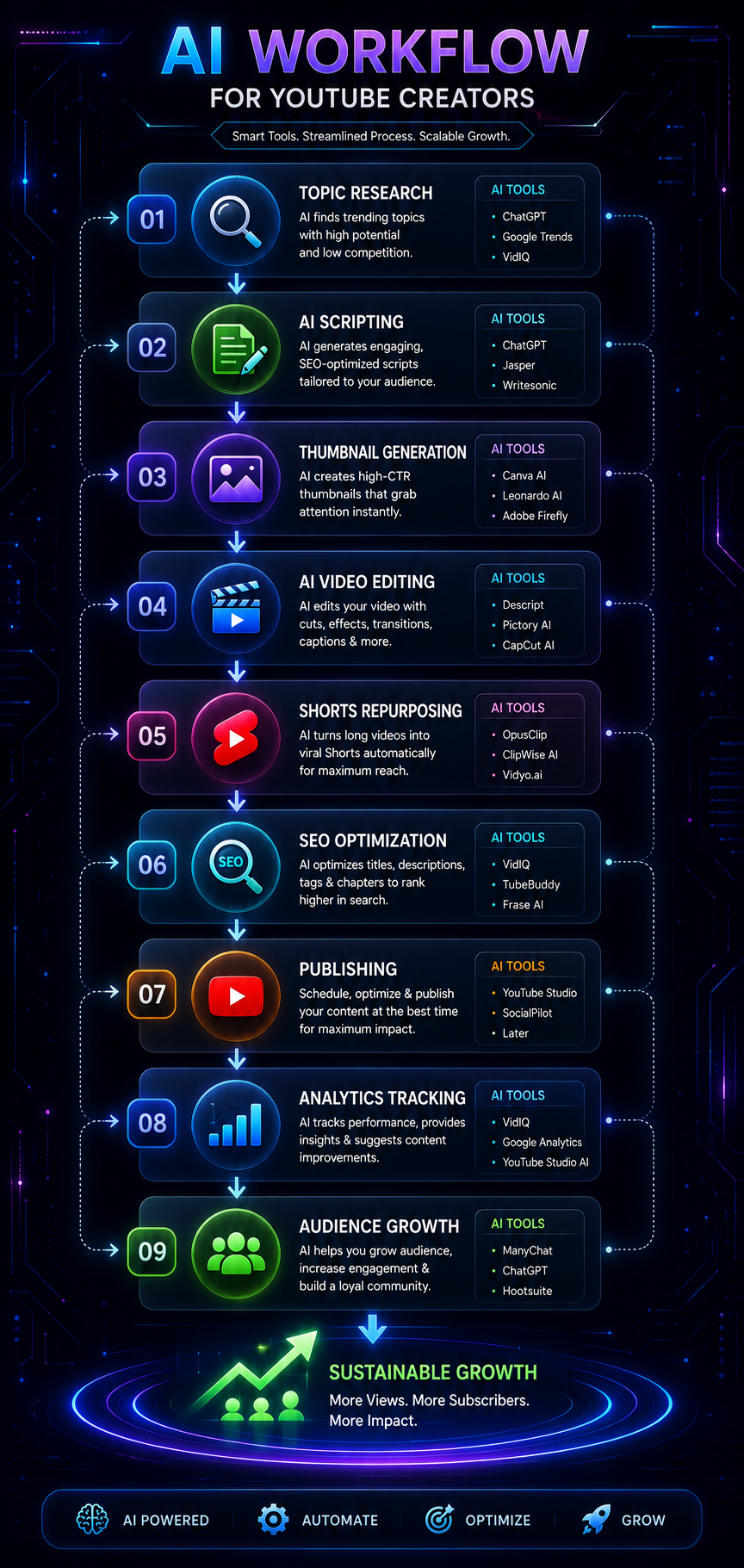
Here is how all these steps connect into a repeatable weekly workflow:
Monday — Research and Planning (1 hour)
- Use Perplexity AI to identify this week's topic
- Validate search demand with VidIQ
- Generate 20 title options with ChatGPT
- Select final title and topic angle
Tuesday — Script Writing (1.5 hours)
- Generate complete script with Claude using your topic brief
- Add personal examples and perspective
- Write 5 hook variations — select the strongest
- Review and refine for your natural speaking style
Wednesday — Filming (1 to 2 hours)
- Film with your final script
- Record 2 takes of your hook — choose the best in edit
- Capture any screen recordings or demonstrations needed
Thursday — Editing (2 to 3 hours)
- Import into CapCut AI
- Run silence removal and auto captions
- Add B-roll, graphics, and music
- Create thumbnail in Canva AI
- Export final video
Friday — Publishing and Optimization (45 minutes)
- Generate optimized title, description, and tags with AI
- Upload video with full metadata
- Add thumbnail
- Schedule or publish
Weekend — Repurposing (30 minutes)
- Run long-form through Opus Clip
- Select 3 to 5 best Shorts
- Schedule Shorts for the following week
- Check analytics on previous video — note retention insights
Total weekly time with AI workflow: 6 to 8 hours. Without AI workflow: 15 to 22 hours.
Common Mistakes to Avoid
Fully automating your personality out of the content. Pure AI-generated scripts read by AI voiceovers produce content that technically exists but does not build an audience. Viewers subscribe to creators they connect with — and AI alone cannot create that connection. Use AI for production, not personality replacement.
Ignoring the hook. Creators spend weeks optimizing SEO and thumbnails while their hooks lose 60% of viewers in the first 15 seconds. The hook is where view duration is won or lost. Invest disproportionate effort here.
Inconsistent uploading. YouTube's algorithm rewards channels that publish on predictable schedules. An AI workflow makes consistency achievable — do not waste that advantage by uploading sporadically.
Chasing trends without a niche. AI makes it easy to produce content on any topic. This tempts creators to chase every trending subject regardless of relevance to their audience. Channels with clear topical focus grow faster than generalist channels at every stage.
Not testing thumbnails. Every creator thinks their thumbnail looks good. YouTube's A/B thumbnail testing tells you what your specific audience actually responds to — not what you think looks good. Use it on every video.
Treating YouTube SEO as optional. Every video you publish without proper title, description, and tag optimization is an opportunity permanently lost. AI makes optimization take 10 minutes — there is no valid reason to skip it.
Advanced AI Growth Strategies
Build Topical Clusters
YouTube's recommendation algorithm increasingly favors channels that demonstrate comprehensive coverage of a specific topic rather than channels that produce content across many unrelated subjects.
Build clusters of related videos around your core topic. If your channel covers AI tools, a topic cluster might include:
- "Best AI tools for students 2026" (main video)
- "AI tools for assignments and essays" (related)
- "How I use AI to study faster" (related)
- "AI tools for student productivity" (related)
- "Free AI tools every student needs" (related)
YouTube recognizes these topical relationships and recommends videos within the cluster to viewers who watched one — dramatically increasing session time and subscriber conversion.
Use Claude to plan topic clusters: I run a YouTube channel about [your niche]. Create 5 topic clusters of 5 videos each. Each cluster should:
Cover a specific subtopic comprehensively Include one main pillar video and 4 supporting videos Target related but distinct keywords Serve a clear audience need
Format each cluster with the pillar video first and supporting videos listed below it.
Mine Competitor Comments with AI
Your competitors' comment sections are the most valuable free market research available. Viewers directly tell you what they wish existed, what frustrated them about the video, and what questions the content did not answer.
The workflow:
Copy 50 to 100 comments from a competitor's high-performing video in your niche. Paste them into Claude with this prompt: Analyze these YouTube comments from a video about [topic]. Identify:
The most common questions viewers had after watching The most common frustrations or things viewers felt were missing The pain points viewers expressed about this topic generally 5 specific video ideas that directly address what these viewers wanted
Comments: [paste comments]
Each video idea that emerges directly addresses a gap the competitor left open — giving you a clear brief for content your target audience explicitly wants.
Build Multi-Platform Distribution
Every video you produce should generate content across multiple platforms through AI repurposing. This is not about building a presence everywhere — it is about creating multiple discovery pathways that funnel back to your YouTube channel.
Repurposing workflow per video:
- YouTube Shorts (3 to 5 clips via Opus Clip)
- LinkedIn post summarizing key insights (via Claude)
- Twitter/X thread (5 to 7 tweets via ChatGPT)
- Instagram Reels (1 to 2 clips via CapCut)
- Pinterest idea pin (via Canva AI)
One long-form video becomes 10 to 15 pieces of platform-specific content. Each piece is a potential discovery point for a new viewer who ends up on your YouTube channel.
The Future of AI YouTube Growth
The direction AI is heading in video content creation over the next 12 to 24 months is worth understanding now — not because you need to implement everything immediately, but because the creators who adapt earliest capture the most benefit.
AI avatar presenters are becoming increasingly realistic and widely available. Channels built around a consistent AI avatar that maintains the creator's voice and personality will become more common — particularly for educational and informational content where on-camera charisma is less critical than information quality.
Real-time multilingual dubbing is making it practical to produce one video and publish it in 10 languages simultaneously — with AI-generated dubbing that matches your lip movements and maintains your voice characteristics. The channels that move into multilingual distribution earliest will gain significant international audience advantages.
AI editing agents are moving toward the ability to take raw footage and produce a complete edited video with minimal human input — selecting the best takes, cutting dead time, adding appropriate B-roll, matching music to pace, and generating captions. Full autonomous editing at professional quality is 18 to 36 months away for most creators.
Personalized content generation — where AI produces slightly different versions of the same video optimized for different audience segments — is on the research horizon. The implications for channel growth are significant.
Related articles
AI Tools
Best AI Tools to Make Money Online in 2026 (Real Income, Real Tools)
The best AI tools to make money online in 2026 — real tools, real income models, and honest workflow advice for students, freelancers, and creators starting from zero.
AI Tools
10 Best AI Side Hustles for Students in 2026 (Make Real Money)
Discover the 10 best AI side hustles for students in 2026. Real income opportunities using free AI tools — from freelance writing to faceless YouTube, digital products, and more. Start with zero experience.
The pattern across all these developments is the same: AI handles more of the production while human creativity, judgment, and audience relationships become the differentiating factors.
Key Takeaways
- AI cuts YouTube production time by 60 to 70% — enabling more consistent uploading without burnout
- The most impactful AI use cases are script writing, thumbnail creation, AI editing, and Shorts repurposing
- Human personality and genuine perspective remain irreplaceable — AI accelerates production, it does not replace the creator
- The complete AI YouTube workflow takes 6 to 8 hours weekly versus 15 to 22 hours manually
- Topic clusters and comment mining are the highest-leverage growth strategies for established channels
- Thumbnail testing, hook quality, and upload consistency are the non-AI factors that most significantly impact growth
Frequently Asked Questions
Can AI actually grow a YouTube channel faster? Yes — but not by itself. AI accelerates the production elements of YouTube growth: script writing, editing, thumbnail creation, SEO optimization, and Shorts repurposing. This enables more consistent uploading and better-optimized content. The channel growth itself still depends on content quality, topic selection, and audience connection — which require human judgment AI cannot replace.
What is the best free AI tool for YouTube creators? CapCut AI is the most broadly useful free tool — it handles editing, captions, silence removal, Shorts formatting, and B-roll generation completely free. Claude AI is the best free option for scripting. Canva AI is the best free option for thumbnails. All three together cover the core production workflow at zero cost.
Is AI-generated content allowed on YouTube? Yes — YouTube's policies allow AI-assisted content as long as it provides genuine value to viewers, discloses synthetic media where required (AI-generated realistic human faces or voices), and complies with YouTube's content policies. Content quality and viewer value are what YouTube evaluates — not production method.
Can AI edit YouTube videos automatically? Current AI tools automate specific editing tasks — captions, silence removal, Shorts clipping, zoom effects, and background removal — but do not yet produce complete edited videos without human direction. CapCut AI and Descript come closest to automated editing and handle most of the time-consuming tasks. Full autonomous editing is emerging but not yet production-ready for most creators.
Do AI YouTube channels make money? Yes — but channels with genuine creator personality and audience connection significantly outperform pure AI channels in subscriber retention, engagement rate, and long-term revenue. Monetization through YouTube ads, affiliate links, and sponsorships all correlate with audience trust — which AI alone cannot build. The winning model is human-led channels using AI for production efficiency.
How many Shorts should I post per week? A practical target for most creators is 5 to 10 Shorts per week generated from one long-form video weekly. This maintains daily channel activity without additional filming. Posting more than 10 Shorts per week rarely produces proportional subscriber growth — consistency matters more than volume.
What AI tool is best for YouTube SEO? VidIQ and TubeBuddy provide the most YouTube-specific SEO data — search volume, competition scores, and optimization suggestions. ChatGPT and Claude are excellent for generating optimized title, description, and tag copy once you have your keyword research. Use VidIQ or TubeBuddy for research and AI assistants for copy generation.
Start Growing Today
The gap between creators using AI workflows and those who are not is widening every month. The tools are available now — many completely free. The workflow is straightforward — and this guide covers every step.
Pick one section of your current workflow to improve first. If editing takes the most time, start with CapCut AI. If you struggle with ideas, start with the Perplexity and ChatGPT research workflow. If your CTR is low, start with thumbnail optimization using Canva AI.
Build one AI-assisted habit into your production process. Get comfortable with it. Then add the next.
The creators growing fastest in 2026 started this process early. The second best time to start is today.
For more on AI tools and content creation, explore the best AI tools for content creators, the how to make money with AI tools guide, the complete AI SEO guide, and the best free AI video generators — all covering tools and strategies that complement this YouTube growth guide.